The Typing Lady
$2.50
Excerpt
I first met the typing lady in a library. “Met” is not the right word. Let’s say I noticed her, became aware of her presence, caught sight of her out of the corner of my eye. She was sitting at a carrel, surrounded by books, typing furiously away on her laptop. It was the typing that drew my attention. The woman herself was nondescript: oldish, in her fifties or sixties, Asian-looking, with black-framed glasses and gray-streaked hair. Not the kind of person one would look at twice, were it not for the typing and the way she scanned the room like an automated monitoring device, her head swiveling one way until her neck reached its limit, then reversing to circle back the other way. She rarely glanced at her keyboard or her screen, yet her fingers never stopped moving, as if she were typing rapid, detailed field notes of her observations, determined not to miss anything.
Ruth Ozeki
Ruth Ozeki is a novelist, filmmaker, and Zen Buddhist priest. Translated and published in over thirty countries, her books have garnered international critical acclaim for their ability to integrate issues of science, technology, religion, environmental politics, and global pop culture into unique, hybrid, narrative forms. She is the bestselling author of four novels, including The Book of Form and Emptiness, winner of the 2022 Women’s Prize for Fiction, and A Tale for the Time Being, which won the Los Angeles Times Book Prize and was shortlisted for the 2013 Booker Prize and the National Book Critics Circle Award. Her debut collection of short stories, The Typing Lady and Other Fictions, will be published in June 2026. Her nonfiction work includes a memoir, The Face: A Time Code, and the documentary film Halving the Bones. A longtime Buddhist practitioner, Ozeki is affiliated with the Everyday Zen Foundation. She is professor emerita of English language and literature at Smith College, where she was the Grace Jarcho Ross 1933 Professor of Humanities.
Hannah Tinti on “The Typing Lady”
In the opening lines of our new issue, “The Typing Lady” by Ruth Ozeki, the narrator observes someone clicking intensely on a keyboard in a neighboring library carrel. Why does she seem so familiar? The narrator watches the typist, like a shadow in the corner of her eye, who in turn watches the world, “determined not to miss anything.”
What follows is a meditation on inheritance and identity as the narrator continues to cross paths with the typist, in bookstores and on the page, while the typist sorts through the typed words of another writer—her own mother.
Is the typing lady real, a manifestation, or a projection of the author herself? The playfulness of Ozeki’s prose makes this initial mystery a reverse-fold in the larger narrative, crystallizing in a visceral moment of love and loss that drives down through each persona until it pierces the heart of the reader, gripping the story in their hands.
In her interview for this issue, Ozeki says, “A story is a collaboration, co-created with a reader, who brings their own lived experience to the page.” This blurring of the lines between reader, writer, and self—a mix of quantum physics and Buddhist thought—is just one of the reasons why I’ve admired Ozeki’s work for so many years.
I’m thrilled to present “The Typing Lady” for collaboration with our readers—the title piece in Ozeki’s first short story collection, a love-letter to all forms of storytelling and the transformative power of the written word.
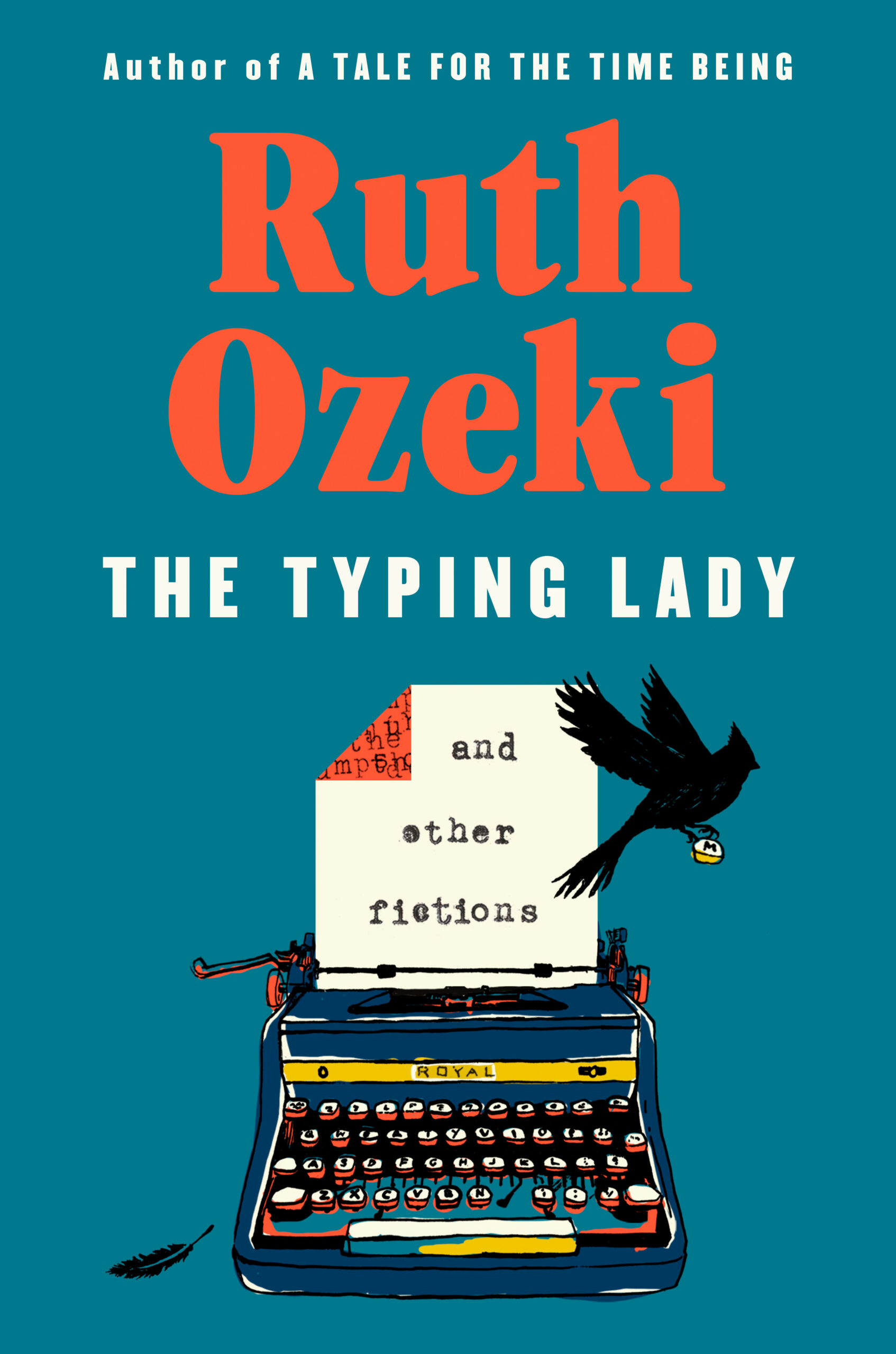
The Typing Lady: And Other Fictions
June 2, 2026, Viking Books
Preorder
Q&A by Hannah Tinti
- HT: Where did this story begin? What was the first image or scene that you wrote?
- RO: I keep a process journal where I make notes about stories I’m writing or want to write. In 2023, I passed an old typewriter store in Cambridge, Massachusetts, and bought a typewriter. A few weeks later, I bought another in New York. The third I bought on eBay. You can see where this is going. Here’s my process journal entry for April 15:
Why am I doing this? Because I am an obsessive compulsive who has a fetish for old writing implements, but that’s not the only reason. I have faith that these typewriters are going to lead me somewhere. I don’t know where, but I hope somewhere interesting. I feel a character inside me, compelling me to buy vintage typewriters. Who is this character? Who is s/he trying to become? (And is this just a self-indulgent justification for more shopping? Very likely.)
Apparently, I had to write the story in order to justify buying all these typewriters. Here’s another entry from May 9, titled “Typewriter story”:Are the typewriters haunted? Do they have some kind of power? Do they have memories? (Computers have memory…) Do they start telling their own stories? The stories of a previous owner?
I like to ask my process journal lots of questions. It's a lot smarter than me, and it usually points me to an answer. A few months later, I realized that the person buying these old typewriters must be the typing lady from my novel The Book of Form and Emptiness, and that led me to the beginning lines of the story. Once I knew that, I wrote the first draft in a day. - HT: Do you use a typewriter to write? If so, how does typewriter creation differ from the pages you produce on a computer?
- RO: Usually I write on a laptop, but sometimes I do use one of the typewriters, or I write by hand, using a fountain pen (yes, I have many). These old technologies have an aura. They force me to slow down, which is helpful when I’m feeling impatient. I love the tactility of typing, the physical effort that your fingers have to make for each letter, the impressions they leave on a page. I love that you can’t erase completely, and so the record of your effort is right out there in the open. I love the sound they make with their movements: the clacks and dings and ratcheting of the rollers and gears. I grew up with typewriters. When I was six or seven, my parents let me use their typewriters to type my stories and poems. I felt like a real writer.
- HT: There are thematic ties in this story to your other works: A Tale for the Time Being and The Book of Form and Emptiness, as well as The Face: A Time Code. In particular, the science of quantum mechanics and entanglement, which happens when two particles act like a single system across space and time. This approach feels different than most autofiction, as it layers different versions of selves, like key pins in a lock becoming aligned and opening a door. Can you talk a bit about how you illustrate the multiverse on the page?
- RO: I love the image of key pins in a lock! That’s what writing feels like on a good day. I’m not a big fan of straight autofiction, but I do like to tweak it and distort it. I have a pretty loose sense of what constitutes a self—if I have one at all. In Buddhism, the self is fluid, an ever-evolving, ever-changing story that is entangled with—and contingent upon—everything else. So, as a writer shaped by Buddhism, I see every story or novel as a chance to explore this array of fictional selves and the interplay between them and the larger world. To paraphrase Walt Whitman, we contain multitudes; I think we write and read to study these multitudes. Similarly, we think of a book as a singular entity written by a singular author, but that’s not entirely accurate. A book, or a story, is a collaboration, co-created with a reader, who brings their own lived experience to the page. So, there are as many versions of my novels as there are readers who pick them up and read them, and each one is unique and different. Using the metaphor of quantum theory, a book exists as an array of potentiality. When it’s read by a single reader, it contracts into a single particulate state—but even that is not entirely true because as readers we change over time, so the book you read when you’re sixteen is not the same book you read when you’re sixty!
- HT: The mother in “The Typing Lady” is an aspiring writer who “wants to be immortalized.” The discovery of this unfulfilled ambition by her daughter is the emotional (and literal) heart of the story. How did you land on this visceral moment?
- RO: The viscera came first. Again, from my process journal:
She starts to believe that there is an organ or mechanism inside the typewriters that’s responsible for this writing. She becomes obsessed with finding it, watches YouTube, learns how to take apart these machines. She wants to find the source of meaning. Does she find it? Maybe it’s a small kidney. A meaty little organ. A heart?
By the time I wrote the story, the heart was associated with the mother’s typewriter. And if the mother left her heart in her typewriter, she must have wanted to be a writer. - HT: “The Typing Lady” is fiction but also a meditation on storytelling, and acts as the author’s note in your forthcoming collection, The Typing Lady. How does this piece serve as an entry point to the other stories in the book?
- RO: It’s a metafictional story, disguised as a “real” note from the author (me), about the interdependent relationship of readers and writers through the medium of a book. It’s recursive—stories within stories, kind of like a mise en abyme—and foreshadows the play at work in the stories that follow. It was so much fun to write!
- HT: What do you hope for your readers to experience as they read The Typing Lady?
- RO: I dedicated the book “To you, of course.” I would love readers to feel like the book is meant for each of them, because it is.
- HT: What are you working on now?
- RO: I’m working on a list of my top ten novels of all time, published in English, for The Guardian. They want it ranked in order by Monday, and I have over fifty. I’m supposed to go back to work on my own novel after I finish, but I don’t see how that’s possible, do you?