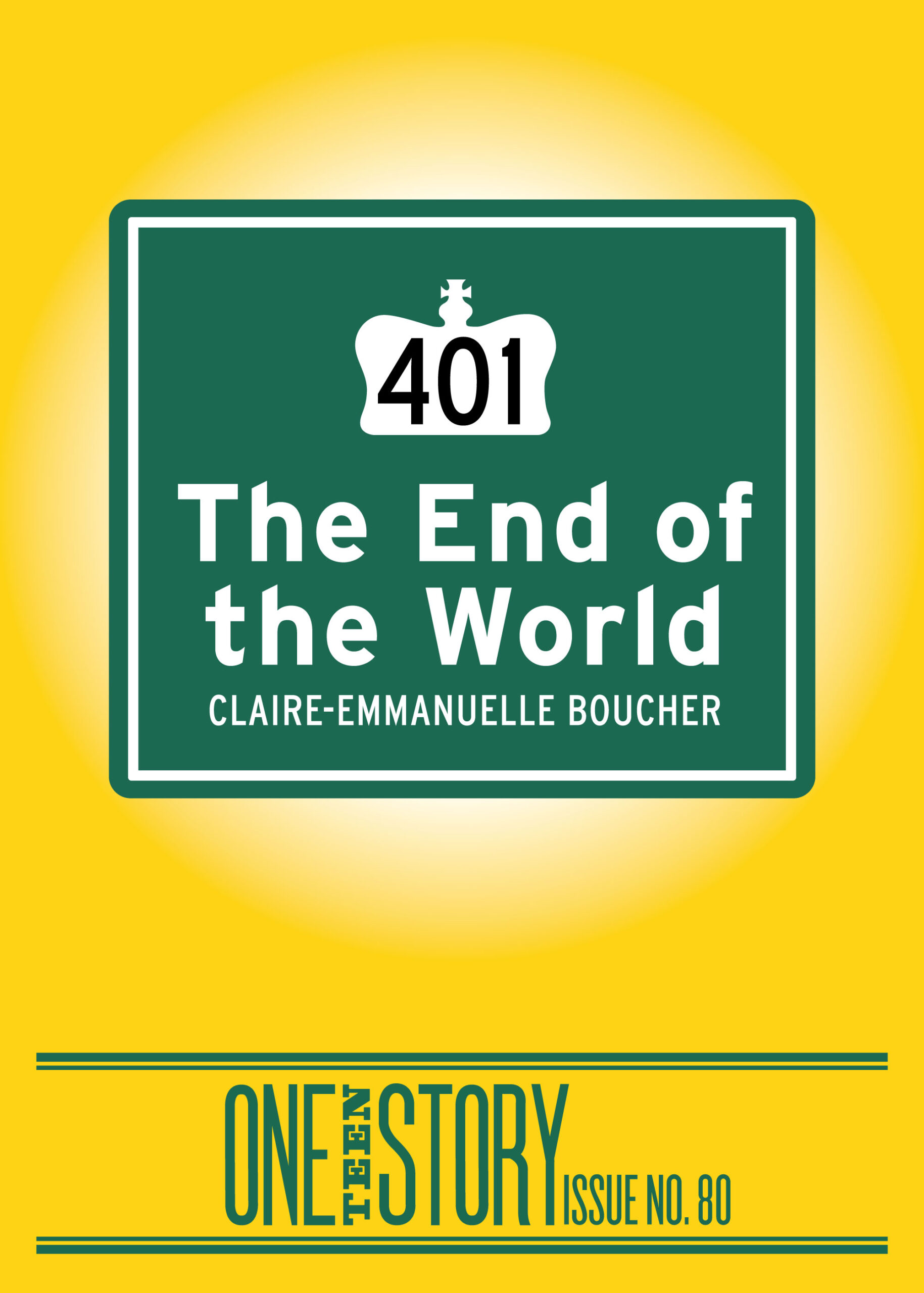
Patrick Ryan on “The End of the World”

When I was nearing the end of my senior year of high school, I was confronted with a dilemma: because of my unimpressive GPA, combined with my abysmal SAT scores, every college I applied for turned me down. I wasn’t an ambitious young person trying to get into a fancy school, mind you; I was a Florida kid hoping to attend an in-state university. With increasing desperation, I watched my friends get their acceptance letters and jump for joy. Many of them had their choice of colleges, because they’d been accepted to more than one. By the end of the school year, I had managed (after jumping through many hoops) to get accepted on probationary status to Florida State University, so there was a happy ending to my dilemma, but I remember well the empty, lonely feeling I had for months, knowing all of my friends were about to move away.

Because of that experience, I identify with Charlotte, the narrator of “The End of the World.” In Charlotte’s case, though, the stakes are even more personal. It’s her best friend and ex-girlfriend, Mira, who’s gotten her acceptance letter and is soon to be on her way, while Charlotte is facing the prospect of being left behind without her. Is it just that she’ll miss Mira as a friend, or that she also regrets their breakup? The end of high school is an emotional time no matter what the circumstances are, and for Charlotte things feel especially bleak. Mira, sensing this, suggests they take a road trip together—to a place known as the End of the World.

This story, written by Claire-Emmanuelle Boucher, is one of the winners of our Teen Writing Contest. I find it to be an admirable and moving piece of writing (the structure and the dialogue, in particular, are impressive), and I hope you enjoy it as much as we did. Please join us in welcoming Claire-Emmanuelle’s story—and One Teen Story’s 80th issue—into the world.

The End of the World

That night, nothing happens.

The air in the pool is warm and the heavy cotton shirt of my uniform bunches up against my bathing suit. I spend three hours on the lifeguard chair without moving a muscle. Nobody falls, nobody strokes, nobody drowns.

It’s dark out when I leave. The supervisor waves from her glass-walled office as I exit the building.

University starts in the fall.

Thirty-seven days until everything’s gone.

*

Mirabel comes to pick me up the next day. I watch my dad eye the new pink streaks in her hair as she shoves my big duffel bag into the already-full trunk.

It took Mira ten minutes, last week, to convince my father that what we needed for our last summer before we left for college was a road trip. Just her, me, the highway. To rectify where we stood, post-breakup. To re-solidify our bond as friends since the past ten-plus years. To have one last big adventure before things got serious. Hell, to celebrate my getting my driver’s license. She spoke nonstop the whole time, like it was a school presentation or a thesis defense. My father sat on the couch and watched her with his lips set into a grim, tight line, not saying anything. Ultimately it was the destination, appealing to his hidden Separatist core, that convinced him:

“We’ll go to Gaspé,” she finished, “See the Canadian cost. There’s this place, they call it ‘le bout du monde,’ the end of the world. I think that’s a perfect destination, don’t you? Sprinkle in some irony to the summer, and explore some Quebec landmarks.”

Now, however, my father is wringing his hands by the door of the house, watching us load up the car. I think he is remembering all the hair-whitening sessions with me at the wheel and him in the passenger seat, patiently coaxing me through left-handed turns and parallel parking.

Mira’s car is old, traces of rust building around the tire caps. It’s also not just hers, no matter what she says: I have so many memories in this car, with her mother at the wheel, on the way to school dances and extra-curriculars.

She slams the trunk shut and brushes off her hands, smiling proudly at me.

“Ready?” she asks.

“Drive safe!” my father calls to us.

I wave back at him as Mira ducks into the driver’s seat. She pulls out of the driveway with an exaggerated carefulness, then speeds up as soon as we disappear around the curb.

“Okay, ground rules,” Mira says, fiddling with the radio knob. “One, we switch drivers every two hours. Two, we’re camping, ‘cause it’s cheap. And three, only fun topics allowed. No sad talk. It’s summer and the world is definitely not coming down around us. Deal?”

I grin. “No problem.”

The city passes by outside the window, all the places and things we know and love. I see us everywhere. The rules she has just set echo through the car: afraid of stepping on each other’s toes, we’re quiet for the most part.

As we turn past the GLEN hospital site, with its brightly-colored departments standing out like a Rubik’s cube, and onto the highway, a song on the radio ends, and the news broadcaster comes on.

Tensions persist in the middle east—

The announcer’s voice cuts off. Mira’s hand is on the knob, frowning down her nose at the screen.

“Fuck it,” she says, “we’re choosing the music.” She presses something on her phone and AJR starts bleeding through the stereo system, singing about getting to the good part.

“Let’s get this party started!” she whoops as we turn onto the highway, the skyline of Montréal at our backs.

And just like that, it’s not awkward anymore.

*

The first three hours go by uneventfully. We make a stop in a little highway town that looks like it lives off truckers and milk production.

“You think this is small, wait ‘till we get to the fishing towns,” Mira jokes, pulling into the Tim Hortons parking lot.

“Why are we even doing this if you’ve already seen all of it?” I ask, raising an eyebrow.

“Because I want you to see it,” she grins, opening the door to get out. The car beeps and then literally sinks in an action I can only describe as powering down.

We get doughnuts and then switch places, me at the wheel and Mira sitting cross-legged in the passenger seat, her water bottle clamped between her thighs and a box of Timbits balancing precariously on top. There’s a pillow in the shape of a giraffe at her feet.

“It’s weird to see you driving,” Mira chirps, her mouth full. “It’s weird to see you do any adult stuff, actually.”

Years ago, Mira and I fell into this dynamic where she did, and I followed. Or rather, she did, and I hid. I don’t know. It gets easy to hide behind your best friend when she’s more than willing to do all the talking. She could talk for both of us, hold on for both of us. If it felt like I was holding onto the past, it was only because I didn’t want to push her away. That is to say, if it felt like I was holding onto the past, it’s because I was. The past was easier, things were easier, before crushes and exams and college came into the mix. And yeah, driving. She came in one day and slammed her driver’s license proudly on the lunch table, but it took me a few years to finally get around to getting mine. What can I say: I didn’t want to sit in a car helplessly while someone else told me everything I was doing wrong. Or right. Or differently. I didn’t want anything to be different. But it was, I guess. So now, instead of being different, or even staying the same, now it feels like everything has been smeared together, like paint on a palette, so the colours blend into each other, one following the next, until I can’t even really see any of them.

Now, I regret this dynamic. I regret letting it form.

A while ago, we started dating. It felt like the right thing to do: everyone thought we were together anyways.  And, yeah, there were feelings. But it gets weird, after a while, dating someone who has trouble seeing you as an adult.

We wanted to leave for college without any ties. We wanted to leave each other when things were still good. We wanted to go and find ourselves, because I didn’t know who I was beyond soccer games and scraped knees and riding in the backseat of my best friend’s mother’s car.

We wanted so many things.

So when she tells me it’s weird seeing me do adult stuff, I answer flatly: “You’ve mentioned.”

She reddens, looks away.

“Sorry. You know what I mean.”

The road is practically empty at this point. The trees on either side of the highway frame my view in green.

“It’s weird to see you drive too, you know,” I tell her apologetically.

She smiles wistfully. “Yeah, I guess. It’s weird, all the adulting we’re doing now. I mean, I had to go buy shit at IKEA for my dorm last week. Furniture shopping is weird.” She pulls another Timbit out of the box and pops it into her mouth.

On the car stereo system, Keeper E condemns us all to drown underwater.

“God, your music taste is depressing,” Mira complains.

“Too bad,” I say, grabbing her Timbit box from and taking one out. “Bite me.”

“That’s what the doughnut is saying to you?” she asks jokingly, grabbing the box back.

“No, but seriously, are you ready? To leave, I mean.”

Mira laughs. “God, no. I mean, I still have a few weeks, but still. And it’s just like, I don’t even know what to bring and what to leave behind. I’m so happy I got into U of T, but Toronto is like six hours away and I won’t be coming back for months, but also, do I really need my entire Squishmallow collection?”

“Yes, you do, absolutely, definitely,” I answer.

She grins. “I know right? But still. You’re so lucky you’re at Concordia. You get to stay in Montréal.”

I nod, my eyes on the road. The asphalt glitters in the sun.

“Well, I think U of T is pretty cool. You’ll have a blast, and I’ll miss you,” I say after a while.

“You better come visit.”

I nod again. It feels like this is the line everyone uses when they leave: you better come visit. Like a few visits will make everything feel like it used to. Like visiting is the equivalent to not leaving in the first place. Like visiting isn’t a small reminder that they are going somewhere and you aren’t, that they are leaving and you’re the one who’s staying behind.

I say: “You said no depressing topics.”

Mira laughs. “Oh my god, you’re right, forget everything. Moving rapidly along.”

As if on cue, Aimee Carty starts singing “2 Days Into College.”

“Skip that right now or I swear to God,” cries Mira, throwing her pillow at me.

“Do you want me to crash this car?” I yelp and laugh as I swerve back onto the road, then grab her pillow and blindly shove it back in her direction.

We switch topics. It is easy, light. Nothing else happens.

*

We get to Rivière-du-Loup early that evening. Mira directs me to the camping plot she booked, the car jumping and rattling on the bumpy road. It takes us a shameful amount of time to put up the tent.

“I thought you were good at this,” Mira complains, looking down at the poles bewilderedly.

“I don’t know where you got that idea,” I grunt, the tent unfolded across my lap.

“I mean, it’s your tent,” she prods.

“It’s my dad’s tent,” I correct her.

“Aren’t you a lifeguard? I thought that means you can, like, do stuff.”

“What does that even have to do with anything?”

We end up googling instructions. The reception is patchy, but present. After almost an hour, the tent is up and anchored into the ground.

“We need food,” Mira announces, dusting off her hands.

We walk to town. Mira’s right: the coastal town looks even smaller and less populated than the one we stopped at earlier. We cross three fisheries before even reaching the center. One of them promises Quebec’s best lobster rolls, so our empty stomachs drive us into the shop and back out with two sandwiches each.

We eat them next to the water, sitting on a big rock. The coast is filled with dark, wet pebbles, the water lapping up overtop. Foam from the waves dissipates before touching the land. Seagulls falter overhead, squawking loudly, before rejoining the air currents. The wind is screaming in our faces, pulling at our hair, tugging at our clothes. Mira sits close, her side pressed up against mine, looking out across the water, peaceful.

I say: “I didn’t get into college.”

Mira yells over the wind: “What?”

I turn and talk right into her ear: “I didn’t get into college.”

She blinks. Once, twice. Then, softer, she says: “What?”

“I didn’t get accepted into university,” I repeat.

She shakes her head. “No, you did, silly. You told me. Remember? You’re going to Concordia. You said.”

“I lied,” I say. It’s simple, a copout, I look away.

“You didn’t lie,” she answers. Immediate, forceful. I can feel her eyes searching for my gaze.

“I lied,” I repeat.

For a second, she says nothing. The wind wails and the waves cry out.

I am leaning forward on the rock, my hands under my thighs, looking out at the water.

“I don’t get it,” she says. “You’re, like, super smart.”

“Not smart enough,” I say.

“What happened?”

“I don’t know. Aimed too high, apparently.”

“So, like, what? You tried to get into competitive programs without any backups? Is that what you mean? That’s okay, you can try again next year, right? It’s not like it’s the end of the world.”

I don’t look at her. The wind is making my face wet.

“Charlotte, look at me,” Mira orders, taking my chin in her hands and turning my head toward her. There’s a beat, then she wraps her arm around my shoulders, drawing me into her. “It’s okay,” she says, resting her head on top of mine. “It’s okay. It’s just college. It’s not that bad.”

“Then why does it feel like it is?” I choke out. I can’t stop my shoulders from heaving. Mira rubs my back and the waves keep lapping against the shore and pulling away again and again and she doesn’t say anything for a long, long time, until it’s too dark to see and we head back to the tent.

*

We don’t bring it up again until the next morning. When I duck out of the tent, Mira is scrambling eggs in a little pan over a portable gas heater.

“So you can’t set up a tent, but you can cook without a stovetop?” I mock her, rubbing the sleep from my eyes.

“We’re gonna have to get this all packed up quickly,” she says without answering me. “I was hoping we could be in Gaspé early this afternoon.”

Her back is to me. I nod.

She turns to face me.

“When did you find out?” she asks. “About university?”

“A few months ago. I was waitlisted. I really thought I would get in.”

She nods, sits down next to her makeshift kitchen.

“So, what are you going to do?”

“I don’t know,” I say. “I really don’t know. I don’t want to think about it. Not exactly a fun topic.”

She nods again, looks down, tends to her eggs.

“I thought camping outside would be noisier,” I say, stepping closer, changing the subject. It’s crazy how good you can get at finding new conversation topics when you’re desperate. It’s crazy how easy it is to forget.  “It was really quiet last night.”

“Except for your snoring,” she shoots back, grinning.

“I do not snore,” I protest.

“You wanna bet? We’re not dating anymore, so I’m not covering it up. It’s the truth. Live with it.”

I wonder for a moment if I actually snore or if saying that is just less awkward for her than saying nothing. I realize I don’t really mind either way.

I sit down next to her. She takes my hand into her lap, traces my fingers, looks up at me, smiling.

“Breakfast?” she asks.

“Please,” I answer.

*

The college thing.

Nothing happened with the college thing.

That was kind of the problem.

Now, everyone keeps telling me it’s okay, it’s not the end of the world, you are smart and capable, there’s still next year.

I went to Grade 12, instead of CEGEP like the rest of the Quebecers. You only go to Grade 12 if you plan on leaving. I don’t know if I planned on leaving. My school offered Grade 12, so I stayed on until Grade 12. And now, everyone is leaving. Everything is changing. But I’m not. And it’s not fair, because I can’t even be mad about it. Because there’s still fucking next year.

We are in the car between Rivière-du-Loup and Gaspé. The Weeknd sings about another day, about second chances and saving back tears. Mira is behind the wheel, the sun glinting off her sunglasses. The window is open, the breeze making the pink streaks in her hair dance. Her elbow resting on the window frame. She says: “Why are you looking at me like that?”

“You look good in this light,” I say.

She wrinkles her nose. “Says the girl who dumped me.”

This is not true. The truth is we were sitting down at a table, just the two of us, talking about her leaving to university six hundred kilometers away, and she was looking over at me, nervous. Nervous, not only because of the distance but because we were distant, different, because telepathically, she could see it wouldn’t work. Telepathically, I’m sure she suggested it to me first. I’m just the one who voiced it.

Telepathy is real when you’ve known someone for long enough.

“Um, pretty sure it was mutual,” I protest.

“That’s just something people say,” she answers, but she’s smiling at me.

I say: “I’m sorry,” but I’m not and I know she isn’t either.

“No, you were right to break up with me,” she answers. “I mean, we were right to break up. We’ve grown. Plus, I’m going to be far.” She winces, remembering. “Sorry.”

I turn away, face the road. “It’s fine. It happened. I need to get over it. I can try again next year.”

I see her nod in my periphery. She says: “I’m proud of you. I’m proud of us. Look at us, we’re so grown up. Moving on. Pursuing life. Adulting real hard here.”

I look over at her and she makes a face. I laugh, not because it’s funny but because I know it’s what she wants.

She starts humming along to the music in the car. I join in: at least her taste in music is easy to sing along to.

*

We get to Gaspé later than we were supposed to. It’s still light out, but it’s that late afternoon light that warms up the sky just enough while still warning you to head home before dark.

“We’re not going to make it to the point today,” Mira says as I turn off the highway. “We should just set up camp and find a place to eat.”

I nod in agreement.

Gaspé is much bigger than Rivière-du-Loup. We quickly find a cute little bistro that has room for us. The tables are small, crammed together, we both order burgers.

“This is going to be the fanciest meal of our trip,” she says matter-of-factly, “because I am one hundred percent broke.”

I laugh. “Don’t worry, me too. The fact that we even made it this far is miraculous.”

On the restaurant’s radio, the sun is escaping from Kinkead and a decision is made not to chase it. Mira is playing with her glass, rotating it in lazy circles on the tabletop. I say: “How much are you gonna miss your mom’s cooking in Toronto?”

She rolls her eyes at me. “Oh my god, so much. It’s not fair. And it’s not just the taste: I’ve recently discovered that cooking actually takes time, too, which is just… crazy, right?”

She looks up at me through her eyelashes, grinning with her cheeks puffed comically.

“Wow, shocker.”

“I know, right?” She looks back down at her drink. Her smile slowly dissipates.

“What is it?” I ask.

She shakes her head. “I don’t know. I… I don’t know. Feels weird to leave everything behind.”

I almost say feels weird not to, or feels weird to be left behind, but I don’t.

“You know how weird this is?” she starts suddenly, looking up at me, smiling forcefully. “The world is going to shit all over, everywhere, literally people dying and wars being waged, and I’m here moping about actually going to college? I’m so sorry, it’s dumb, don’t listen to me. Only fun topics allowed. Only fun topics.”

“Not dumb,” I say. “But I’m sure once you’re there you’ll have a great time.”

“I know, I know,” she says, going back to playing with her glass again.

*

The cicadas chirp so loud that night that they wake me up. I open my eyes slowly.

The tent ceiling is low. I can feel the ground under my mattress. I am lying on my back, my eyes open, when Mira turns over to look at me, her mattress creaking under her. Her eyes gleam in the dark, wide open, glassy.

“What are you thinking about?” she whispers.

“College,” I say, without looking at her. “And everyone leaving.”

“Me too,” she answers, matching my position and turning to look up. She adds: “I wish this didn’t feel like the end.”

“Me too,” I say. There’s a hint of disappointment in my voice that I try to bury. Or maybe it’s fear. I don’t know.

The cicadas outside call out to the emptiness. It sounds like an electrical pulse, like maybe we’re going to be vaporized in a few seconds. Nothing happens, we lie in the dark, universities start in thirty-five days.

“Do you think this was a good idea?” asks Mirabel.

She’s talking about us getting together to begin with. And breaking up. And taking this trip together. The answer’s the same for all three.

“Yes,” I say, reaching blindly until my hand touches hers.

She turns over to face me, her sleeping bag rustling.

“I know it’s dumb, but I don’t want to lose you.”

I take a liberty I am not allowed to. I stroke my thumb down her face. I say: “You’re not losing me. It’s just college.”

She nods, leans into my touch.

“I love you,” she says, and it is soft and rhetorical and platonic and perfect. And then she turns away, back to her side, leaving me on mine.

It is past midnight. The cicadas keep chirping.

*

Our camping plot is in Parc Forillon, the same national park as the supposed end of the world. The next morning, we follow the walking trail signs set up throughout the park. The hike takes three hours.

Mira says: “Ready?”

The first half is roughly flat. We walk through the trees, trading the backpack containing our lunch and water bottles every half-hour or so. It’s still pretty early when we leave, so we’re the only ones on the trail. Everything is green, as far as I can see, in all directions, the leaves blocking out the sun. The woods are quiet, with the exception of the occasional squirrel rustling the leaves. I can hear our feet hitting the ground, the clinking of the backpack straps, Mira’s breath. It feels weird to talk when we are the only noise, so we stay quiet.

The path begins to slope upward about halfway. A wooden arrow points up the slope, with the words Le bout du monde engraved on it.

Mira finds a rock to sit on and declares a water break. I climb up to sit next to her, taking a big swig out of my water bottle.

Mira says: “I’m breaking the fun topics rule. It sucks you didn’t get into university.”

I look at her. She is stroking the side of her bottle thoughtfully, looking down at its contents. I wait before answering. Then, I say:

“It sucks that you did.”

She laughs, shakes her head.

“Yeah, it does.”

I grin, take another sip of water.

“I’m sorry I said you still had next year,” she continues. “Next year doesn’t matter. It’s now that does.”

“Right?” I look back at her. “I’m sorry I said you’d still have fun. You’re allowed to be scared.”

She looks over at me, smiles, nodding, then looks down again. She thinks for a while.

“It’s like people forget that things can suck right now, even if they won’t later. Even if nothing happened. I don’t know if that makes sense.”

It does. I nod. She knocks her head back and takes a drink from her bottle. We stay silent for a second. After a while, we agree to start moving again. I jump down from the boulder, stumbling as I hit the ground.

“Why do all our revelations have to happen on giant rocks?” I grumble, brushing leaves off my pants.

“The bigger the rock, the better the thinker,” Mira says matter-of-factly, taking off up the path.

*

We get to the point about a half-hour later. There’s a little lookout, framed by a wooden fence. We walk up to the fence. Our hands grip the edge as we look out.

And it looks like the end of the world.

The land falls off quickly, a sharp cliff down to the water, no trees, almost no shrubbery, just yellow rock straight down. We stand on the edge of the cliff, jutting out from the mainland, curving on our left all the way back to where we started walking. And on either side, in all directions, nothing but water. Waves roar as they crash against the rock. There is nothing, nothing, nothing but water and sky and the ground under our feet.

We spend an eternity in silence. Mira is breathing beside me, in, out, the sound of our breaths peeking out behind the sounds of the waves below and the wind rippling around us.

“It’s funny,” I say without looking at her, my fingers curling around the wooden fence, “I keep waiting for something to happen. Something to justify feeling this shitty. Like, I don’t know, I want a reason to be mad at the world that isn’t as stupid as not getting into college.”

Mira says nothing for a while, then nods quietly.

I turn to look at her.

“I’m gonna miss you,” I say.

She smiles, looks down.

“Me too.”

I say nothing for a while, staring off. Then I turn to her and ask, almost jokingly,  “Why does it still feel like the end of the world?”

She takes a step forward, looks out over the cliff. The wind is pulling her hair back, whipping it around her head like a pink and brown halo. She turns back and grins. When she speaks, her voice is almost a yell, buffeted by the wind.

“Because it is.”

She turns and grips the barrier with her hands, leaning over the edge.

“It’s the end of the world!” She hoots.

I laugh, joining her, screaming at the sky, the water, our words swallowed by the wind. We scream until our throats are raw, and when we stop, the “end of the world” looks exactly the same. Not a wave or a blade of grass out of place.

I lean my head on Mira’s shoulder.

We stay there for a long time, facing the end of the world defiantly. Then, after a while, we turn and start the trek back.

Claire-Emmanuelle Boucher

Claire-Emmanuelle Boucher is an aspiring Canadian writer from Québec, Canada. She is currently studying Neuroscience at McGill University in Montréal. Her previous work has been published by Font Magazine and the Diverse Minds Writing Competition. She writes both in English and French and loves to incorporate both languages in her work. In her free time, she likes reading, biking, playing music, and cuddling with her dog. Read an interview with Claire-Emmanuelle Boucher about “The End of the World” here.

Issue cover design by Stefan Lawrence.