
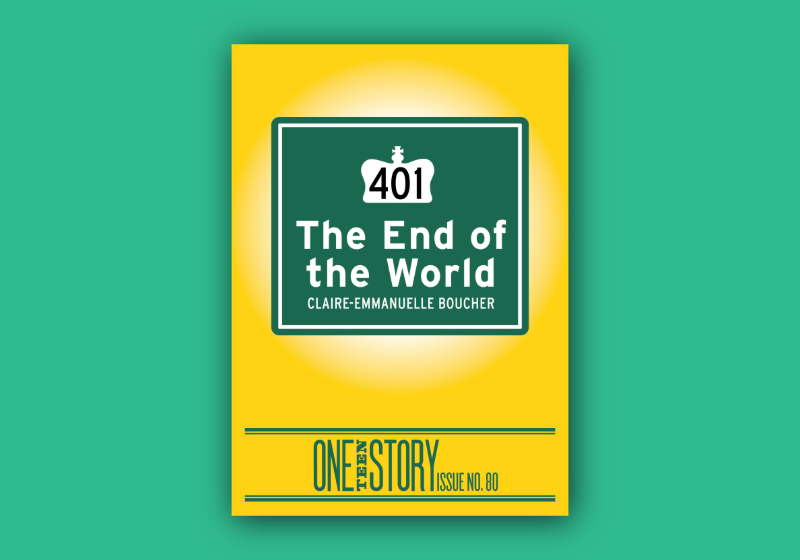
What do you do when your best friend is about to leave for college and it feels like the world is ending? Take a road trip together to a place called The End of the World, of course! Buckle up for an emotional ride with our Teen Writing Contest winner, Claire-Emmanuelle Boucher, author of “The End of the World.” In this interview with Patrick Ryan, she discusses the craft of dialogue, writing humor into painful experiences, and how she imagines things turn out for the characters after the story ends.
PR: Where did you get the idea for “The End of the World”?
CB: I went to Gaspé a little while ago. There is a lookout, not exactly the one in the story but still, with a wooden railing blocking off the cliff. As is the case with many public places, there was a lot of graffiti on it, but one thing I saw that really stuck with me was the phrase: “If I let you go, would you fly?” That really resonated with me. I kept thinking, what’s the story there? So, though I didn’t end up including the phrase in this story because I felt like it didn’t quite end up aligning with the characters’ growth, it is what spurred the whole idea.
PR: How long did the first draft of the story take you to write?
CB: Keeping up with the car trip theme, I wrote my first draft in the car between Montréal and Toronto! So, about five hours.
PR: You tackle some big emotional experiences in the story, like a breakup and what life is like for the two people involved—in this case Charlotte and Mira—after the dust has settled. You also tackle the fact that one of them is about to move away, leaving the other behind. How did you approach these things without getting heavy-handed? Were you conscious of incorporating humor?
CB: In my experience, pain can be very, very quiet. If you get too heavy-handed, you can lose some of the beauty in that. There’s something in the quietness, an acknowledgement that life is so many things, life is so layered, and no matter what happens in it, it never stops. Life goes on, you go on. I think the things Charlotte and Mira go through in the story are pretty basic things that I would say most everyone has gone through at some point or another, and they are things that hurt, of course, but at the end of the day they are still friends determined to have fun, and that means joking around and doing some silly things. The humor wasn’t purposeful, but I guess it just felt right to balance the “big emotional experiences,” as you put it.
PR: There is a fair amount of dialogue in the story, and you write dialogue very well. Do you read your dialogue aloud to yourself as you write, or when you’re revising? Do you like writing dialogue?
CB: Thank you! I don’t usually read dialogue out loud to myself, but I’ll often run it through my head before writing it down. Writing dialogue kind of feels like a game for me, or, if I know the character well enough, even a movie: who’s going to talk next, what are they going to say? I am and always have been a very verbal person; dialogue is the best part of a story, in my opinion, whether you’re writing it or reading it. I think the key to a character is dialogue. I tend to refer to my characters like friends as opposed to creations; you get to know a friend via what they do and say, so that’s how I know my characters, and that’s how I want other people to know them. Dialogue comes easily because of that, and I think it’s fun to write, so yes, you could definitely say that I like writing dialogue!
PR: Have you thought about Charlotte and Mira in the future? If so, do they stay in touch? Are they in each other’s lives, in some fashion, ten years from now?
CB: I kind of imagine them losing each other, honestly. I can’t seem to get myself around that. But I would hope they find each other again later as adults, yeah, maybe ten years later, after they’ve lived a little and experienced life. Then, I’d hope they could reconnect, maybe spontaneously, like bumping into each other in a coffee shop or something, and remember a bit about their past and what they meant to each other, maybe rebuild a solid friendship.
PR: What did you do when you found out you were one of the winners of the One Teen Story Writing Contest?
CB: Funny story about this one, because I was in a biology lecture and the projector wasn’t working so we were all following the professor’s slides on our phones. When I got the notification, I read it over probably a dozen times. I must have looked very invested in mitochondrial inheritance, or whatever the lecture was about! Honestly, I don’t remember what he was saying at all because I was just freaking out in my head. It was very exciting and completely unexpected!
PR: What are you working on now?
CB: Nothing concrete, but I’m having fun working on a sort-of anthology of short stories about a last-ditch attempt to save the human race. It’s not as dystopic as it sounds, I promise! It’s tentatively called Les Maillons, and it’s about societal pressures, what divides us, and what it means to be valuable. If that sounds interesting, its surely because I’m making it out to sound better than it is, but I’m certainly having fun with it.
PR: What’s the best piece of advice about writing you’ve ever heard?
CB: My third-grade English teacher used to say you had to “throw up on the page, and then clean it up.” Apologies for the needless grossness, but I think it’s really true: if you delete everything you find sub-par, you might never get anywhere! I think it’s better to leave everything on the page, whether it’s completely disordered, irrelevant, or horrible (or most likely amazing!) and then fine-tune afterwards from what you have, rather than produce a perfect piece from start to finish but get frustrated or blocked. It’s always better to make something that is utter crap and then fix it than make nothing!
Claire-Emmanuelle Boucher is an aspiring writer from Québec, Canada. She is currently studying Neuroscience at McGill University in Montréal. Her previous work has been published by Font Magazine and on the Diverse Minds Writing Competition website. She writes both in English and French and loves to incorporate both languages in her work. In her free time, she likes reading, biking, playing music, and cuddling with her dog.