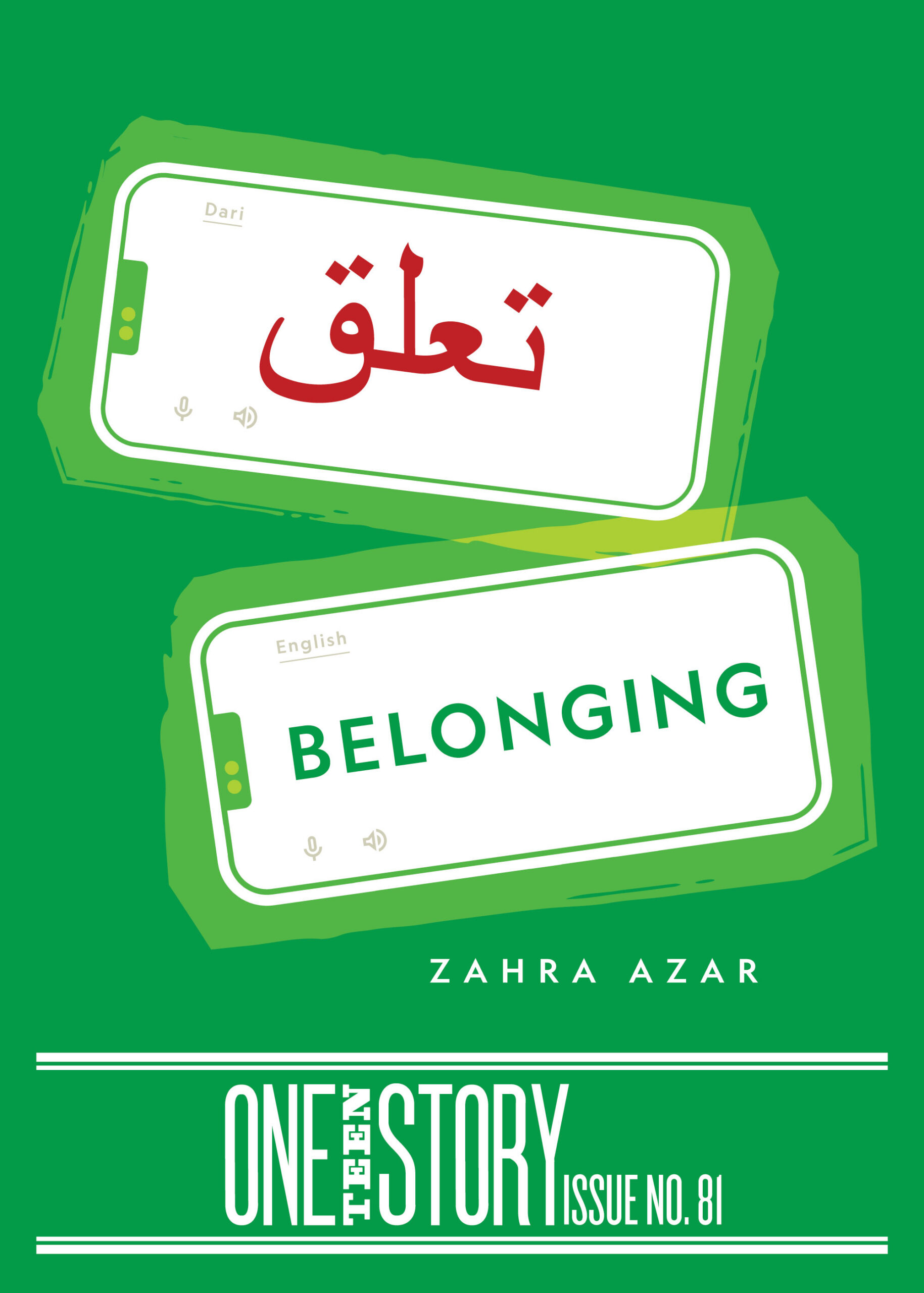
Patrick Ryan on “Belonging”

After the U.S. withdrawal from Afghanistan in 2021, teen writer Zahra Azar felt compelled to do something to help Afghan refugees, so she began volunteering with Afghan Refugee Relief. There, she worked with newly arrived families and, in particular, unaccompanied children—many of whom spoke no English upon arriving.

As she learned what these families and these isolated children had been through, Zahra was struck by the fact that refugees are very often labeled and stereotyped in unflattering ways, and that refugees rarely seem to be regarded as individuals. In addition to her volunteer work, she wanted to do something to help change that way of thinking, so she started taking notes on a fictional character named Zoleikha.

The result of those notes is the winning short story in the ages 13–15 category of our 2026 Teen Writing Contest. Zahra Azar is a highly skilled, deeply empathetic writer who will surely go on to write and publish more. We at One Teen Story are delighted to usher “Belonging” into the world.

Belonging

When I got off the plane, I already felt like I didn’t belong. They spoke English; I whispered to myself in Dari. They had family waiting; I had nobody. They traveled for fun; I traveled because I had no choice. I didn’t come for adventure. I came because my house had been bombed, because, if I hadn’t left, I never would have had the chance to make something out of my life.

At Kabul International Airport, the crowd surged, voices shouting, bodies pressing. My mother’s hand slipped, my brother’s voice vanished. Pushed toward the gate, I clutched my mother’s scarf, the only piece of home I’d taken with me.

I snapped out of it. I was in America now, somewhere called Los Angeles.

I shuffled into the immigration office and sat in a dim room, a shiver running up my spine. The officer entered, red‑haired, gun at his belt, his nametag unreadable squiggles. He looked tired, as if he’d stopped listening to stories like mine. A young woman followed, emerald eyes searching me, black hair in a braid, scarf tucked into her coat.

“Salam, Zoleikha,” she said softly, in Dari. My heart jumped. Salam. It was the first word I’d heard all day that felt like home.

Her name was Laila, she told me later on. She was born in America, but her parents were from Kandahar. She spoke Dari with a slight accent, but it didn’t matter. It was enough to make me feel like I wasn’t alone.

The officer flipped through his folder, his eyes bouncing from me to the files. His eyebrows rose each time he flipped a page, higher and higher.

“Zo-leek-ha,” he said, dragging each syllable. My name bent under his tongue, unfamiliar and awkward. That wasn’t my name; my name was Zoleikha. I wanted to correct him, but the words stuck in my throat. I didn’t know how to shape them in his language. To him, my name was just letters on a page, another sob story.

His voice broke the cold silence of the room, his tone impatient. Once again, more words I couldn’t understand. To me, they were only noise filling up a room. He pointed at me, talking to Laila. She nodded and looked at me, her voice gentle.

“He is asking about your family, Zoleikha. Do you have anyone here in America?”

“Ne, hech kas,” I whispered. No, no one.

She nodded and turned back to him, translating my words into English. He let out a breath of air, as if he were annoyed that I was causing him trouble. He tapped his pen against the folder. He spilled more English out of his mouth, looking at Laila. She nodded again, turning back to me.

“He wants to know where you will stay. Do you have a home here?”

I looked at her, my voice shaking. “N-no,” I said in Dari.

She looked at me with compassion in her eyes. She turned back to the immigration officer and spoke. He sighed and looked through my files again. They were discussing me. It hurt that people were talking about me without giving me the opportunity to speak or have a say. They said something about an “unaccompanied child,” not that I understood what that meant. The room felt colder each time they glanced at me. I pressed my mother’s scarf against my palm, as if it could warm me, as if it could remind me that I was still me. Finally, Laila looked back at me, and she spoke to me this time.

“You will go to a shelter sponsored by the Office of Refugee Resettlement. It is where children like you go first, when they come alone. They will keep you safe until they find you a family, or find your family.”

Office of Refugee Resettlement. I didn’t know what that was, but from the look on Laila’s face, it seemed OK. I let a hollow breath out and nodded for what might have been the millionth time someone had nodded in that room.

*

The twenty-four hours blurred. A van ride. A building with locked doors and white walls. Other children sat quietly, some whispering in languages I didn’t know. The girls and boys slept in separate houses, but we would periodically see each other in the main areas. I clutched my scarf tighter, my notebook pressed against my chest. I sat on the edge of a table, thinking about everything that had happened in the past day. I felt more alone than ever. I missed my mother, my brother, the markets on the streets of Kabul, the smell of fresh bread from the bread seller, and Dari. I missed everyone speaking a language I knew. I missed belonging somewhere.

And then I heard it. Not words, but a melody. A boy sat across the multipurpose room from me, his shoulders hunched down over his phone, humming. The tune was soft, almost swallowed by the silence, but I recognized it. It was an old Afghan lullaby, one my mother used to sing when we had too much chai and couldn’t fall asleep.

“Aa lalo bacha lalo,” he sang under his breath. Aa lalo child, lalo. It was just a whisper, but it was enough for me.

“Pasè darbachah lalo…bâbait pay shekâr rafta,” I sang. Your father has gone hunting. His head snapped up, and for a second, the darkness in his face eased. Together, we finished the lullaby, our voices weaving through the cold space like a secret only we knew.

The boy relaxed his shoulders. “Salam,” he whispered.

“Salam,” I whispered, waving, my mother’s scarf pressed to my body.

His name was Farid, from Herat. He was sixteen, a year older than me. He had been separated from his uncle at the airport in Kabul and was not able to be reunited. He’d been at the shelter about a month.

He said he was still here because no one wanted teenagers. I thought about that word as we sat in the cafeteria. Teenagers. Not a child, yet not an adult.

“Why don’t families want teenagers?” I asked Farid between spoons of cereal. It was stale, but I was so hungry I didn’t care. American food was not appetizing.

Farid shrugged, twisting the bracelet on his wrist. “They want little kids. Easier. They don’t ask so many questions.”

I noticed that anytime we talked about being “wanted,” he would fidget with that bracelet. It must have meant something to him.

“I like your bracelet,” I remarked, pointing to his wrist.

Farid glanced down, twisting it again. For a moment, he didn’t answer, just looking at the bracelet as if it were his lifeline. Then, he looked back up at me. “My mother made it. Before…everything.” His voice trailed off, but I could see the weight of the memory pressing on him.

He gave a small smile, the kind that flickered and faded quickly. “She said it would keep me safe. I don’t know if that’s true, but…it’s the only thing I have left of her, of my past life.”

I pressed my mother’s scarf tighter against my chest. “I have this,” I whispered. “My mother gave it to me at the airport. I didn’t realize I was holding it until I was already here.”

He smiled, and suddenly everything else didn’t feel so heavy. Usually, in our culture—even at the shelter—boys and girls our age weren’t really allowed to just sit and talk alone. But with our interpreters occupied with shelter staff and paperwork, we were able to just be. We sat next to each other, both of us clutching the last pieces of our mothers. His bracelet, my scarf. They were small things, but they carried whole worlds inside them.

In that cold room, surrounded by strangers and silence, it felt like we had carved out a corner of belonging. Not Kabul, not Herat, but something in between.

For the first time since the airport, I didn’t feel completely alone.

The next afternoon, Farid pulled a worn deck of cards from his pocket. “Do you know panjpar?” he asked, shuffling them with practiced hands.

I nodded. My brother used to play with me in Kabul, teaching me how to count the tricks and how to win with patience instead of speed. God, I missed my family. My case manager had finally been able to get a hold of my mother in Afghanistan, obtained some permissions for me, but the connection was lost before I had a chance to speak to her.

We sat in the middle of the lounge, playing. It was fun getting to do something with someone else.

“You’re good,” he said, shaking his head after I won another round. “My brother taught me,” I replied, smiling for the first time in days.

The door opened, and Laila stepped in, holding a folder. She watched us for a moment, her expression soft. “You’re lucky, Zoleikha,” she said warmly. “A family has agreed to take you in. You’ll go to a foster home tomorrow while you wait for your family.”

My smile faltered. A foster home? The words felt heavy, strange.

Laila crouched beside me, her voice gentle. “I’m excited for you. They’ll take care of you. It’s a chance to start fresh, go to school—your mother wanted you to go to school.”

I nodded slowly, though my chest tightened. Farid looked down at the cards, twisting his bracelet. I pressed my scarf tighter against me, wishing the game could last forever.

*

About an hour before I was supposed to leave, I found Farid sitting alone in the recreation room, curled up in a plastic chair next to a window. He glanced at me, silent. My stomach churned, and I felt guilty. Why couldn’t Farid go to a home while I could? It wasn’t fair.

“Where will you go?” I asked, breaking the silence.

He shrugged. “I don’t know. If I don’t get reunited then probably wait till I’m eighteen, here, then…maybe I’ll go back to Herat. Find my family.” The Office of Refugee Resettlement claimed to have a goal of always trying to reunify unaccompanied children with their families…if possible.

I nodded, my throat burning. “That sounds…good.” It was honestly crazy how much emotion I was feeling right now. I’d met this person three days ago, yet he felt like family. Maybe it was because he sympathized with me, because he had gone through the same thing I had.

For a moment, neither of us spoke. The air between us was thick with everything we couldn’t say. My eyes stung, and when I blinked, I saw that his were shining too. Just a little.

I swallowed hard, my chest tight. It amazed me how much sympathy could do, how it could build a bridge between two strangers who had nothing else. We had no families here, no homes, no certainty about tomorrow. But in these three days, Farid’s understanding had been enough to make me feel seen.

Laila came into the room. “Zoleikha, it’s time.” She looked at us and smiled. “Don’t worry, I will make sure you guys can keep in touch, I promise.”

We didn’t cry, not fully. Just a shimmer in our eyes, a heaviness in our throats. It was the kind of goodbye that didn’t need words, because empathy had already said everything.

*

The car hummed as we passed the shelter gates. The driver kept his eyes on the road, but I would sometimes catch him glancing at me with pity. Laila sat in the passenger seat, flipping through a folder. I sat in the back, clutching my backpack, staring at the blur of buildings outside.

“They’re called James and Emily,” Laila began in Dari, her voice calm, almost rehearsed. “They’re American, in their thirties. They can’t have children of their own anymore. Emily used to be a teacher, but after their only daughter passed away, she stopped teaching.”

I swallowed hard. I was a replacement. They lost their child, and I was a fill-in. Hopefully a temporary one—inshallah—God willing.

“They’re kind people,” Laila continued. “Remember that they are still sensitive about the whole situation. They want to give you a home. They want to take care of you.”

I nodded slowly, but something still wasn’t clear. “What about school?” I whispered. The whole reason I came here was so I could attend school.

“I knew you were going to ask that. You’ll go to Oakwood High School,” she said, glancing back at me with a reassuring smile. “It’s a good school. You’ll take ESL classes, English as a second language. They’ll help you learn.”

I sighed in relief. I could have a life. “But…how will I talk to people? I don’t know how.” I frowned.

Laila’s smile widened. “You’ll learn. At first, it will be hard. You’ll use gestures, simple words. Teachers and students will help you. And in ESL, they’ll teach you step by step. You don’t have to be perfect. You just have to try.”

Her words sounded simple, but they didn’t feel simple to me. My stomach churned. I imagined walking into a classroom where everyone spoke a language I couldn’t understand. Their laughter and words would rush past me like water I couldn’t catch. I would be the outsider, the one who couldn’t speak. I pressed my scarf tighter against my chest. “What if they don’t like me?” I whispered, my voice barely audible.

Laila turned in her seat, her eyes kind but firm. “They will. People are kinder than you think. Even if it feels lonely at first, you’ll find your place. You’re stronger than you know.”

I wanted to believe her, but fear pressed down harder. I wasn’t just scared of school, I was scared of being in a house that wasn’t mine, with people who had lost a daughter and now expected me to fill the silence she had left behind.

The driver glanced at me in the mirror, his eyes soft but unreadable. I looked away quickly, staring at the blur of houses outside. Every mile carried me farther from Farid, from Kabul, from everything I knew.

I whispered to myself, so quietly no one could hear: Aa lalo bacha lalo. The lullaby steadied me, just enough to keep breathing.

*

The car pulled into a quiet street, stopping in front of a house with a succulent garden in the front. My stomach was in knots as Laila turned to me. “We’re here.”

James and Emily stood at the door. James had blond hair, Emily red. Their shoulders were slightly raised, tense, but their faces softened when they looked at me. Emily held her hands tightly together, and James kept glancing at her before looking back at me. They looked kind, but fragile, like glass.

When I stepped out, holding my mother’s scarf close, Emily smiled nervously. “Kush omadeen,” she said awkwardly. I looked at her, surprised. She was trying to say Khush Amadayn. Welcome.

James smiled and waved.

“Zo-leik-ha,” he said carefully. He said something in English, which I once again did not understand. Laila nodded and looked back at me.

“Zoleikha?” she asked. “They are asking if they can call you Zoe until they can properly say Zoleikha? They want you to be comfortable, so whatever you want.”

I thought about it. Being called Zoe could be like a fresh new start. I nodded, cracking a smile.

“H-hello,” I hesitated. That was the only word in English that I knew, and pretty much the first time I spoke it.

Emily’s eyes widened, her smile trembling with surprise. “Oh! She speaks English?” she whispered, glancing at James. She looked a bit relieved.

Laila nodded. “She knows a few words. She’ll learn more in ESL classes.”

Emily nodded with a little smile. I noticed she had a Dari phrase book in her hand. I wondered where she got it from, how much time she spent reading it.

They said something and pointed to the door. I followed them in. The hallway was quiet; the air had a hint of cinnamon.

James gestured toward the living room, still practicing my name under his breath. “Zo-leik-ha…Zoe,” he said carefully. Emily gave me another smile, nervous but kind, and held the phrase book close. Laila trailed behind me, looking at another file.

We stepped into the living room. It was cozy, with lots of bookshelves. The furniture looked neat but worn, as if it had been waiting for someone. I sat on the armchair. James and Emily sat across from me on the couch, Laila joining them. They were going through a stack of paper, signing each one. My eyes wandered around the room.

On the mantel above the fireplace was a framed photograph. A little girl with bright eyes and a wide smile. Her hair was tied back with a ribbon, and she looked about eight years old.

My chest tightened. Their daughter.

Emily noticed my gaze and hesitated, her hand pausing over the papers. She pressed the phrase book against her lap, her smile trembling. James cleared his throat softly, continuing to sign the papers, though his jaw tightened.

I looked back down, holding my scarf. I didn’t know what to say.

About ten minutes later, Emily took me to my room. She led me down the hallway, stopping at a door near the end. She opened it slowly, almost nervously, as if she wasn’t sure what I would think.

The room was neat, with pale walls and a quilt covering the bed. A small desk sat by the window, and on the dresser was a lamp with a soft yellow shade. It didn’t feel like mine, but it was quiet, and it was safe.

I stepped inside, holding my backpack. Laila and Emily stayed in the doorway, watching as I set it down on the bed. My hands moved slowly, pulling out the few things I had. My scarf, folded clothes, and my passport. I put them on the desk, one by one.

Then my fingers brushed against something I didn’t remember packing. I pulled it out and froze.

Farid’s bracelet.

The leather was worn, the beads scratched. He must have slipped it into my bag before I left. My throat tightened as I held it in my palm.

I set it down on the desk, staring at it. I looked at everything I had. My mother’s scarf, clothes, my passport, and now this bracelet. Little pieces of what I had left behind, lined up in this strange new room.

Laila cleared her throat. “Take your time,” she said, still standing in the doorway.

I nodded, unsure what to do next.

Laila left soon after that. She promised she would come soon, and said if I needed anything, I should call. She also told me that Emily would set up regular phone calls with my family in Kabul, as the connection allowed. That was a relief.

Later that evening, Emily knocked on my door, her phone glowing. She held it out toward me. On the screen, words appeared in Dari: Dinner is ready.

I looked at the phone, then back at her. She smiled nervously, waiting for me to understand. I nodded and followed her down the hall.

When I came down, James was already there. He had his phone next to him, too. I sat down in front of a plate. Dinner was pasta with beef. For a second, I hesitated. I didn’t know if the beef was halal, slaughtered according to the Muslim requirements. At the shelter, I had eaten no meat whatsoever, so the worry of eating non-halal meat never crossed my mind.

James noticed me pausing. He tapped at his phone, turned the screen toward me. The words appeared in Dari: Don’t worry. We got halal meat.

I looked up at him. He smiled and pointed to the food. I smiled back and picked up my fork. The food wasn’t like my mother’s, but it still tasted good, finally.

Dinner was quiet after that. Emily and James spoke to each other in English, their phones resting nearby in case they needed to reach me again. I kept my eyes on the plate, eating slowly until it was clean.

When I carried my dish back to the sink, Emily gave me another small smile, nervous but kind. I nodded, then slipped back into my room.

The bracelet was on the desk where I had left it. I glanced at it before changing into my pajamas. I lay down on the bed. The quilt felt heavy, the house quiet.

I couldn’t sleep. Too much had happened for me to sleep. I turned from side to side, hearing every small noise. Every sound felt louder in the silence.

At some point, I sat up and looked again at the desk. My scarf, my passport, my clothes, the bracelet. They seemed to glow faintly in the lamplight, reminders of everything I had carried to America, to that house. Eventually, exhaustion pulled me under.

​*

When I opened my eyes, light was shining on the quilt. It was morning. The house was quiet, save for the faint clatter of dishes somewhere down the hall. A knock came at the door.

Emily stood there, her phone glowing in her hand. She held it out toward me. On the screen, in Dari: Time for school.

I tried to take everything in. Today was my first day at Oakwood High School. I went to the bathroom and got ready. I wore a gray hoodie and black jeans. I pulled my hair into a ponytail, leaving two strands out, like my mother used to do.

Back in my room, I reached for my backpack. Before I left, I saw Farid’s bracelet. I picked it up, turning it over in my hand. The leather was worn, the beads scratched, but it felt solid, familiar.

Without thinking too much, I slipped it onto my wrist. It rested there lightly, but it made me feel better.

I put on my backpack and took a deep breath. Then I stepped out of the room, ready to face the day.

*

Emily waited by the door. I followed her out, the bracelet around my wrist.

The car smelled faintly of coffee. I went for the back seat, I hated the front. A small paper bag sat on the seat beside me. Inside was buttered toast and a banana. I ate slowly as the car moved through the streets.

James glanced back from the driver’s seat, his phone resting in the cup holder. He tapped it and words appeared on the screen facing me: Breakfast okay?

I nodded. I had learned another phrase in English. “Thank you,” I said and smiled.

James grinned, turning around with his phone. He tapped it, and more words appeared in Dari: You’re welcome. He smiled, as if proud of me for trying. Being around a non-related male in such close proximity was a major adjustment, but his kindness put me slightly at ease.

The car rolled past rows of houses, then larger streets lined with shops and signs I couldn’t read. The butterflies in my stomach grew the closer we got. Finally, we stopped in front of a big building. Oakwood High School. Students streamed through the doors, laughing, talking, their voices loud and fast. I pressed my forehead lightly against the window, watching them. James looked at me and waved. I stepped out and started my first day.

​*

It was the worst. The hallways swallowed me whole. Lockers slammed, sneakers squeaked, voices rushed past in English I couldn’t catch. In Kabul, boys and girls went to different schools. It was better. Less noisy. Less wild. I kept my eyes on the ESL teacher that the office introduced me to and followed her into a small classroom.

She smiled kindly, but when she spoke it got drowned out. The other students opened books, their eyes moving quickly across the pages. I stared at mine, the letters twisting into shapes I couldn’t read—an extreme change for me. I had been the brightest in my classes, always. Not now.

The teacher would point at me, encouraging me to try. I was silent every time. A boy in the back laughed. I pulled my hoodie up, my face red. I stayed quiet for the entirety of the class period.

At lunch, I carried my tray to an empty table. No one cared about me here. I asked someone if there was a place for me to pray, and they shook their heads, confused.

By the end of the day, my head throbbed. Every word had been a wall I couldn’t climb. When the final bell rang, I walked out slowly, the crowd sweeping around me.

Emily and James waited by the car. Emily smiled, but I couldn’t return it. I slid into the back seat, staring outside. My first day was over, and all I felt was failure.

​*

When I got home, I had a call scheduled with my mom. Knowing that it had to be brief, I knew that I could not worry her. When she asked me how I was—“Chetor astee?”I could not answer it honestly. I filled her with hope and happiness that I was studying. I would be OK, inshallah.

That night, I couldn’t hold it in anymore. I curled up in bed, clutching my scarf, and the tears came hard. I sobbed until my chest ached, until the quiet house felt like it was pressing down on me. I missed Kabul, my mother, my brother, even the crowded streets. I missed belonging.

The door creaked open. Emily’s voice was uncertain. “Zoe?” She stepped inside, her phone sticking halfway out of her pocket. “Oh, honey…” She crossed the room quickly and wrapped her arms around me. I stiffened at first, then let my body lean into her warmth.

She pulled back enough to look at me. “How was school?” she asked gently.

I wiped my eyes, searching for words. One came to me, a word I had learned today. “Bad,” I whispered.

She looked at me, then got out her phone. She typed into it, then showed it to me, tears in her eyes.

I looked at the screen. When my daughter was eight years old, she died in a school shooting. That’s why I stopped teaching…It brought too many painful memories. But…you reminded me why I taught in the first place, because teaching someone how to read is the best gift you can give.

I stared at the words on the screen, my breath catching. My chest tightened, not only from my own sadness but from hers. Emily’s eyes glistened, her hands trembling as she held the phone.

For a moment, neither of us spoke. The silence was heavy, but it wasn’t empty. It was filled with everything we had lost.

Emily reached out, brushing a tear from my cheek. “You reminded me why I taught,” she whispered, her voice breaking. “Reading is a gift. And I want to give it to you.” I didn’t understand what she said, but I knew it was meaningful.

Moments later, she returned with a stack of books, thin ones, with bright pictures and simple words. She set them on the desk, her hands lingering on the covers.

I touched the bracelet on my wrist, then the scarf folded on the desk. My mother’s love, Farid’s strength, and now Emily’s belief in me.

Emily opened the first book, sliding it toward me. “Read,” she said softly.

I nodded, wiping my eyes. The letters still looked strange, but for the first time, I believed I could learn them.

​*

It took months. Every day after school, Emily sat with me to practice. At first, the letters refused to make sense. I stumbled, mixed them up, frustration burning in my cheeks. But Emily never rushed me. She smiled, pointed again, and waited.

Slowly, the shapes began to open. A was the start of the alphabet. B was the beads on Farid’s bracelet. C curved like my mother’s scarf. Piece by piece, the alphabet became less of a wall and more of a path.

One evening, I sounded out a word alone. “Home,” I whispered. Emily’s eyes filled with tears, and she hugged me. “Yes,” she said. “Home.”

Seasons passed. I read signs on the street, words on the board, labels in the kitchen. Each word was a victory, each sentence a step closer to belonging.

I still cried, missing Kabul and Farid. I spoke to my mother more frequently, with more hope of seeing her one day. The bracelet gave me strength, the scarf reminded me of her love, and Emily’s books reminded me of possibility.

I wasn’t just surviving anymore. I was learning. With every word, I was building a new life.

Zahra Azar

Zahra Azar is a graduating eighth-grade writer from California whose work often explores identity, belonging, and human connection. Her writing has received multiple awards, and “Belonging” is her second published piece. Outside of writing, she participates in Model United Nations, where she has also earned several awards. In her free time, she enjoys reading and storytelling. Read an interview with Zahra Azar about “Belonging” here.

Issue cover design by Stefan Lawrence.