
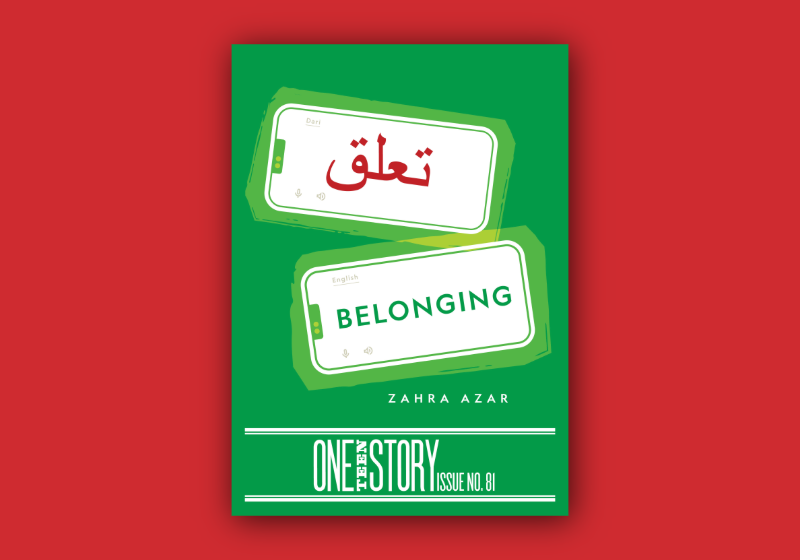
In Zahra Azar’s Teen Writing Contest–winning story, “Belonging,” a young Afghan refugee is separated from her family for her own safety and, though she speaks no English, sent to live in a foster home in Los Angeles. In this interview with Patrick Ryan, Zahra talks about her experiences volunteering with refugee families and what she hopes readers will take away from this story.
PR: Where did you get the idea for “Belonging”?
ZA: The idea for “Belonging” came from my experiences volunteering with Afghan refugees through Afghan Refugee Relief, after the U.S. withdrawal from Afghanistan in 2021 and the subsequent takeover of the Taliban. I spent a lot of time helping newly arrived families and was even recognized by my local newspaper for my volunteer work. Through that experience, I learned about many refugee stories, especially those of unaccompanied children who arrived in the United States without their families.
Seeing their resilience made me realize how lucky I am to have my family with me. While “Belonging” is a work of fiction, kept broad for safety reasons, it was inspired by the people I met and the stories I heard. I wrote it as a tribute to Afghan refugees, especially unaccompanied children, and to the people who help support them.
PR: How long did the first draft of the story take you to write?
ZA: Once I had the idea, I spent a couple of days thinking through the plot and outlining the story. The actual writing took about five days. I wrote for around an hour each day, so the first draft came together over the course of a week.
PR: The point-of-view is first person and sticks entirely to Zoleikha’s perspective. I found that worked well in the story because it’s such a personal and private thing your character is going through. As you were writing in her voice, was there anything about the story that surprised you? Any discoveries about her that you made along the way?
ZA: Yes, she had a lot of character development that I didn’t really expect at the start, like slowly finding her voice even though she can’t speak the same language. One moment that really stood out to me was when she was learning how to read, because it genuinely made me emotional while writing it. It made me realize how something as simple as reading is actually a huge blessing that we often take for granted. Almost like color in a picture.
Writing in first person also helped me understand on a deeper level what many children in situations like hers have to go through, especially the strength it takes just to adjust and keep going.
PR: What do you want readers to take away from this story? What message or sentiment would you like them to hear?
ZA: I don’t want people to just feel sad after reading “Belonging.” I want them to feel moved and inspired to help in whatever way they can, even in small ways. It doesn’t have to be something big like helping refugees specifically. It can be something simple like giving food or money to an unhoused person you see on the street, or just showing kindness when you can.
I also want readers to think differently about refugees and people in similar situations. Sometimes they are reduced to labels or stereotypes, but through this story I hope people can look past that and really see them as full human beings with real stories, emotions, and struggles, instead of making assumptions.
I also wanted to show their resilience and how, even after going through so much, they keep going and try to rebuild their lives in a completely new place. That strength really stayed with me while writing.
At the same time, I want people to feel grateful for what they have. You never really know when things in life can change or be taken away, so I think it’s important to appreciate even the small blessings we often overlook and see them as something meaningful.
PR: Have you given any thought to writing more stories about Zoleikha? Or more stories that deal with someone in her shoes?
ZA: Yes, I have thought about it a lot. I don’t think Zoleikha’s story is finished yet. I feel like she still has a lot ahead of her, and her path could go in different directions, like maybe she gets reunited with her mom and brother, or maybe she doesn’t. I honestly do not fully know yet, and I think that uncertainty is what makes me want to keep exploring her story.
I have also thought about writing a story from Farid’s point of view. I am really interested in stories like these because they are something I have been able to witness and learn from in real life. It feels personal to me, in a way, not just something I am imagining. I am very excited to continue writing more stories in the same world and with similar themes.
PR: What did you do when you found out you were one of the winners of the One Teen Story Writing Contest?
ZA: I remember I was in the car on my way to basketball practice when I checked my phone and saw an email saying I had won. I literally gasped and couldn’t believe it at first. I was just staring at the screen because it didn’t feel real. I told my parents right away and it was such an exciting moment, like everything just stopped for a second.
I also told my English teacher, because he really helped me throughout the process, and I wanted him to know too. It honestly felt like one of those moments you’ll never forget.
Ultimately, I felt gratitude for the opportunity to tell Zoleikha’s story and bring some focus on the newly arrived children who come with hope to a new home.
PR: What are you working on now?
ZA: I am currently entering more writing contests and also working on a screenplay that I am really hoping will go big one day. I also started writing a book some time ago, and I hope to finish it soon. Alongside that, I have been mentoring younger students with their creative writing, which has been a really meaningful experience for me. I like being able to help them develop their ideas and confidence as writers while continuing my own projects too.
PR: What’s the best piece of advice about writing you’ve ever heard?
ZA: The best piece of writing advice I have ever heard is “Show, don’t tell.” My English teacher told me this when I came to him with an idea for a story. It really changed the way I write because it pushed me to focus more on details, emotions, and actions instead of just explaining everything directly.
Another thing I have learned is that you do not always need to have a completely clear idea when you start writing. A story can develop as you go, and things can come together over time in a way you might not expect at the beginning. That has helped me a lot with my own writing process.