
On April 24th at our Literary Debutante Ball, One Story will be celebrating five of our authors who have recently published or will soon publish their debut books. In the weeks leading up to the Ball, we’ll be introducing our Debs through a series of interviews.
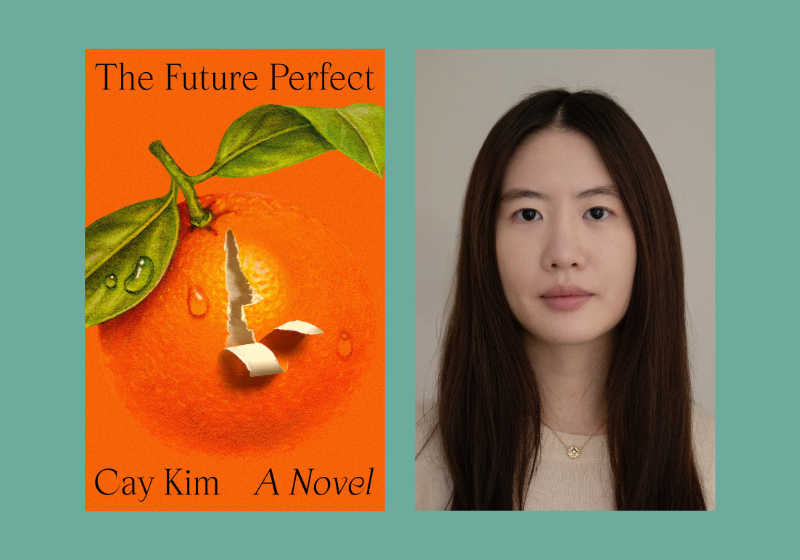
Today we’re talking with Cay Kim, author of One Story issue #336, “Secret,” and the novel The Future Perfect (Riverhead), a radiant portrait of a young woman caught between cultures, and what is lost and found in the struggle to succeed.
A couple weeks ago Riverhead, the publisher of Cay Kim’s debut novel, The Future Perfect, posted an animation by Kelly Emmrich to their YouTube channel. In it, the colors are muted, dark shades of blue and gray thread together to form the image of a mother, then a simple living room, with a couch and a clock with a pendulum, then a window with a hazy view. The video is accompanied by a voice that reads a scene from the part of the novel after the “you” (the protagonist) and her mother’s consciousnesses have bifurcated. “Black tufts of hair stick out from her head, frizzed from the weather,” the voice reads as the clip closes, “and at the sight of a silver strand you feel a wave of protectiveness, tamping her hair down in place with your hands.” In this interview we discuss the strange nature of second-person narration, the jumping-off point for the novel—a long poem—and the harsh realities of achieving excellence.
— Nico Mestre
Nico Mestre: Where were you when you found out The Future Perfect was going to be published? How did you celebrate?
Cay Kim: I was home and went out to dinner at my favorite restaurant!
NM: How did you come to write about this mother-daughter relationship? The two of them are close, but their intimacy frays as the novel progresses. Did you always know, before writing, that this chasm would form between them, or was that something you discovered while drafting?
CK: The mother-daughter relationship is closely based on my relationship with my own mother. I suppose I began writing about her because even though I was physically separated from her, out creating a life for myself in the adult world, my relationship with her occupied most of my interior—which in actuality is where I live most of my life. In the novel, the initial intimacy does fray between the mother and daughter, but I think it is eventually replaced with a more complex, furthered intimacy—a kind that is only made possible with time.
NM: A professor of mine once said second-person narration lures the reader into a state of hypnosis. Meaning the reader becomes convinced that “you,” the protagonist, is really you, the reader. Why did you choose to narrate the novel in second-person, and was it always written that way, or did you find that you were drawn into that point-of-view during the process?
CK: I hadn’t thought about the second-person in terms of hypnosis, but I think that’s right. I think internally, that is what I hoped to achieve in the first few chapters, which is where I find the second-person to serve the most interesting purpose, because it’s before the perspective permanently shifts to the daughter’s, and the consciousness of the second-person is in this gray area, shared between the mother and daughter. I wanted the idea of two physically interconnected people occupying one consciousness to feel as hypnotic, strange, and sublime as it actually is. This kind of meticulous engineering often goes unnoticed by the reader, but I think novels are often filled with them, and that they unconsciously enrich the reading experience.
NM: There is a poetic register to the novel. One of my favorite lines is written with a searing directness: “It is a rule in your family to keep it all in.” Did you find the form of the novel, compared to poetry or short fiction, particularly conducive to this intensity of language?
CK: The first conception of this novel was actually a long poem I wrote under the guidance of a mentor. I put it away for a long time with no intention to return to it, until one day it occurred to me: what would happen if I expanded each of the stanzas into chapters in a novel? Like you’re pointing out, intensity of language is often more sustainable in smaller forms such as poetry, or short fiction, but in some ways each of the chapters function as short fiction since they are isolated moments in time and do stand on their own. I think it would have been harder for the poetic register and intensity of language to be maintained in a novel with a traditional narrative structure and without chapters—which nods to the adage that form must follow function.
NM: I noticed some parallels between your forthcoming One Story issue #336, “Secret,” and The Future Perfect, specifically your focus on competitive children who get carried away with validation from adults and its potential to prove their own excellence. Why do you keep returning to child characters with desires to please adults in your fiction?
CK: That’s interesting to think of “Secret” in terms of the narrator wanting validation from adults. Rather than wanting validation from the adults in her life, given none of them want her to participate in the singing competition, I think it’s more likely that she wants validation from the real world—that is, the world of adults—or what she perceives to be the real world through the television, the limited window she has of life outside her rural town. In the novel, I’m not sure if the narrator has any room to develop any desire for excellence on her own terms, since she is swept up by her mother’s desire for her excellence, which is difficult to separate from her mother’s love and devotion to her. But you’re right that I have an interest in writing about child characters who are faced with the pressure to prove their excellence, which I think is simply because I’m interested in people, and I think that in our modern society a lot of children are faced with that pressure, which is difficult to not become harmful.
NM: There are several descriptions of labor throughout the novel: the mother is constantly found cooking, cleaning, and rearranging; the daughter works tirelessly, studying until her eyes burn; and the novel itself begins with a scene of labor—the mother’s contractions, the daughter’s birth. Did you experience the craft of this novel as a sort of labor?
CK: Of course, creating any work to completion requires labor, but different types of labor vary deeply in the amount of pleasure they entail, and writing this novel was one of the most pleasurable experiences of my life. I had the luck that this novel arose naturally out of a previous poem I wrote, with a straightforward initial design of expanding every stanza into a chapter, so I didn’t have to undergo the process I am now, with my second novel, of sitting through a prolonged period of meticulous thought and contemplation prior to diving into the actual writing. But like you said, the novel—as well as the OS story “Secret”—is very interested in labor and in the esteemed value society ascribes to endurance and hard work, and what the personal cost of that is to actual people in society.
NM: Lastly, what are you most looking forward to at the One Story ball?
I’m looking forward to meeting the wonderful people of the One Story community! Having the resources to pursue art is a gift, and artists can’t survive without the various communities that support them. I’m so grateful to all of my friends, readers, editors, and everyone involved in the arts, and I’m so thrilled and honored to be part of the One Story ball.
Before moving to Brooklyn, Nico Mestre studied creative writing and linguistics at Emory University and completed a flash fiction collection—including stories that meet the page as lists, eulogies, and recipes—for his senior thesis. He previously worked as a fact-checker for BOMB Magazine and he currently splits his time between One Story, as the 2025-2026 apprentice, and a local bakery.