
On April 24th at our Literary Debutante Ball, One Story will be celebrating five of our authors who have recently published or will soon publish their debut books. In the weeks leading up to the Ball, we’ll be introducing our Debs through a series of interviews.
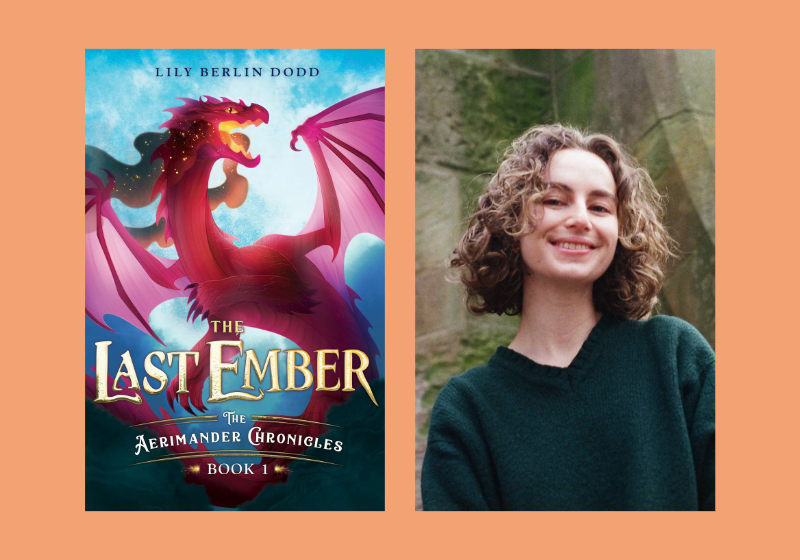
Today we’re talking to Lily Berlin Dodd, author of One Teen Story issue #30, “A Eulogy for Pretzel” and the novel The Last Ember (Farrar, Straus and Giroux BYR).
In The Last Ember, Eva Alexander, a wealthy twelve-year-old chemistry student in the city of Porttown, purchases a beautiful object that just happens to be the highly sought-after egg of the Aerimander—a species long thought extinct. As a result, Eva becomes the target of unwanted attention from the Thieves’ Union and the Director of Kingdom Secrets, Eoin Parnassus, who both want the egg for themselves. When Eva and her newfound friend Dusty realize the importance of the egg in their possession, they realize it’s not just their fate, but the whole world they are fighting for. The Last Ember is about friendship, courage, class, power, conservation, and the common good. The book itself is a treat to behold—with its lush cover, interior map, and red edged pages, upper-middle-grade readers will feel like they too are holding a prized possession.
—Tara Lindis
Tara Lindis: First! We want to hear all about where you were when you got the news that your book sold! How did you celebrate? Who did you share the news with first?
Lily Berlin Dodd: I happened to be at home in California, which was really lucky because it meant I got to celebrate with my parents and my childhood best friend. She and I were supposed to meet up at the mall later that day, so I told her there. Definitely made the shopping more fun.
TL: Your debut has gotten so much press! How has this part of the process been, of seeing the wide reception of your book? And it comes with a map! Did you design it while writing?
LBD: The marketing and publicity teams for this book, especially my publicist, Sam Sacks, have been so amazing. One of the coolest things they did was make a promo box for the advanced reader copy of The Last Ember. Like, the cover of the book was printed ON the box, and then there were little goodies inside. One of these was a pouch printed with the title, and in it was a teeny tiny silver egg. I heard about a kid who read the book and decided to turn the pouch into a necklace and wear it to school. That made me so joyful. I totally would have done that in middle school, too.
I think more than any other moment in the whole book-creation process, seeing the map knocked me over (with delight). I always love a book-map, so the fact that I got one—and that it was so beautifully executed—was a dream come true. I didn’t design it at all, for this book or the sequel. I sent a bare-minimum sketch (like circle, square, line) to my editor, and she passed it on to the incredible Charis Loke, who is the map artist.
TL: I feel like you could teach a class on how to organize and plot not just one novel, but an entire series. Can you give some insight into your process about how you keep track of Eva’s adventures with the Aerimander egg, the Union of Thieves, various spies, etc.? What is your organizational process? (Scrivener? Spreadsheets? Post-Its on the wall?)
LBD: Thank you! I plan in a bunch of different ways. Usually, I start by writing a pitch for myself—basically, the summary on the back of the book that would make you want to read it. That copy never shows up again, but it’s really helpful to me as a starting point. Then I outline, write, realize something isn’t working, outline again, write again, etc., etc.
In this particular book, without spoiling anything, there’s a pretty serious plot twist near the end of the story. And it literally twisted up the planning—all the plot threads got tangled because of this one choice I’d made. So I had to plan that really carefully, on a corkboard, with string and Post-It notes.
TL: Eva is the friend I wished I’d had in middle school: grounded, enjoys her looks but isn’t vain or arrogant, loves chemistry. I love that Eva is both a scientist and appreciates beauty (her own! her birthday dress at the very beginning, the allure of the egg that starts her adventure). What inspired her and her interest in chemistry? How much research did you have to do?
LBD: As a former twelve-year-old girl myself, I wanted to give Eva a lot of confidence, especially in the areas where I hadn’t been confident as a tween. So, as you note, Eva likes the way she looks, she’s completely unstressed by academics, and she barges into a lot of situations without totally thinking them through. Her best friend, Myrnie, on the other hand, is cautious and anxious—an over-thinker and a ruminator, as I can be. But both girls absolutely dominate in their respective fields; they are wonderful and steadfast friends to each other, and they have strong senses of justice. I wanted to show that courage and love can manifest in many ways—the relationship between the two of them is a cornerstone of the series as much as the relationship between Eva and Dusty is.
As for science, I was inspired by my own best friends, two of whom are engineers. I saw how hard they worked in college and beyond (we were roommates for three years), and I wanted to honor that dedication in these characters.
TL: Some characters (I don’t want to give anything away) meet a violent end or violent circumstances. Full disclosure: I’m a parent and aunt of middle- and elementary-school kids. Kids are obviously exposed to violence in the world via the news, movies, or sometimes in their own lives, and I think there is something honest and validating to seeing violence in their fiction and to see someone like Eva encounter it. It’s also true middle-grade fiction has some history of violence: Harry Potter gets dark, A Series of Unfortunate Events gave ME nightmares! How did you make these plot choices in writing middle-grade fiction? You write it well and obviously think middle-grade readers can handle it (and we love writers who think highly of their readers!), but you also obviously put thought into it.
LBD: That’s really a valuable perspective to me, to hear from a parent. I’m not a parent myself, but I have been a teacher, and I’m sad to say that I agree with you—kids of all ages are grappling with the real-world cruelty they hear about or encounter.
There are a few instances of violence in this book, but I don’t write violence for its own sake. I think that would be irresponsible. Violence in the world of The Last Ember is a tool of oppression, and the scales are not balanced. Here’s Dusty with a slingshot and Parnassus with an entire army. The second book will explore more, especially for Dusty, the emotional aftermath of that imbalance.
TL: Eva and Dusty start out as enemies, and then they become friends as they both realize the stakes involved in keeping the egg safe. This conflict of protecting a resource versus exploiting it is very timely. So is the dilemma of handling the unforeseen consequences of current choices (Eva and Dusty don’t know what happens when the egg hatches). Can you talk about your process in handling these issues many tweens and teens might be thinking about right now?
LBD: Yes, that tension between protection and exploitation is central to the book, and it gets more complicated as Rubi hatches and gains autonomy. Rubi is “the last ember”—one remaining individual in a species everyone thinks is extinct. Neither Eva nor Dusty view her as a resource to be exploited, nor as a resource at all. She’s a family member, for better or for worse, which also makes Eva and Dusty family to each other. I wanted to play with all those themes: conservation, power, found family, responsibility, autonomy. And I really credit my editor, Grace Kendall, for drawing a lot of those themes closer to the surface of the story.
TL: Lastly, what are you most looking forward to at the One Story ball?
LBD: I’m so excited to have been invited to participate in the ball—One Teen Story was a huge part of my development as a young writer. If you had told me at sixteen when my story came out that I’d be a debutante about a decade later, I would have run around screaming with joy. And that’s still how I feel, but I do that sort of thing in the privacy of my own home now.
I can’t wait to meet the other debutantes and read their books, all of which sound fantastic. And I’m really looking forward to getting to thank my mentors. And to dress up in an outfit and dance. And to have a personalized beer, which has never happened to me before, and probably won’t again.
Tara Lindis is a reader at One Story, and a volunteer at WriteNYC (formerly Writers in the Schools at PEN America). Her work has appeared in Kenyon Review, Pithead Chapel, Fourth River, and elsewhere. Originally from Portland, Oregon, she now lives in Brooklyn, New York, with her family.