
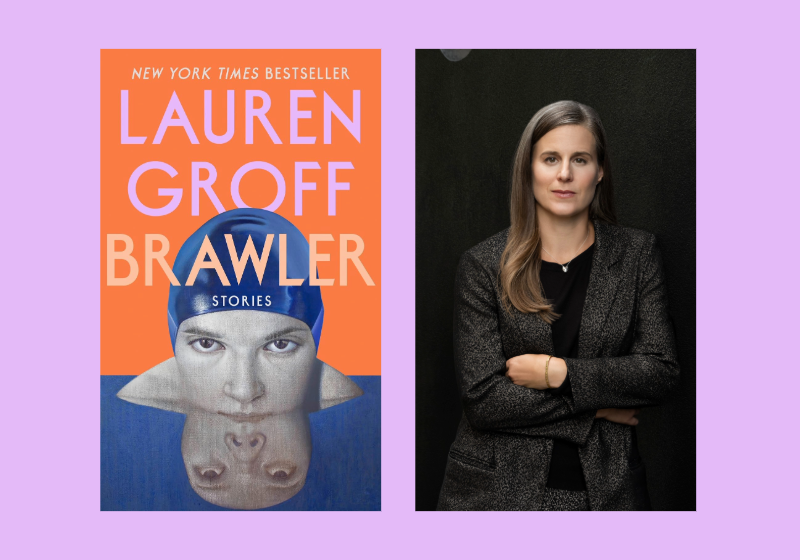
On April 24th at our Literary Debutante Ball, One Story will be honoring a past One Story author who has gone on to make a significant contribution to literature and the literary community. The 2026 Distinguished Alum is Lauren Groff, author of One Story Issue #112, “Sir Fleeting.”
Lauren Groff is The New York Times–bestselling author of the novels The Monsters of Templeton, Arcadia, Fates and Furies, Matrix, and The Vaster Wilds, and the celebrated short story collections Delicate Edible Birds and Florida. She has won The Story Prize, the ABA Indies’ Choice Award, France’s Grand Prix de l’Héroïne, and the Joyce Carol Oates Prize, and has been a finalist three times for the National Book Award. She has held fellowships from the Radcliffe Institute for Advanced Studies, the American Academy in Berlin, and the Guggenheim Foundation, was given the Howard D. Vursell Memorial Award by the American Academy of Arts and Letters, and was named to Time Magazine’s 100 Most Influential People list in 2024. Her work regularly appears in The New Yorker, The Atlantic, and elsewhere, and has been translated into thirty-six languages. She lives in Gainesville, Florida, where she and her husband own the independent bookstore The Lynx.
In her new collection, Brawler, Lauren Groff returns to the short story and proves once again that she is a master of the form. Each piece takes the reader on an unforgettable journey in the airtight space of a dozen or so pages, the sentences delivering in ways that make it impossible not to read on, such as “The Wind,” which opens: “Pretend, the mother had said when she crept to her daughter’s room in the night, that tomorrow is just an ordinary day.” The characters in this book make choices that are sometimes hopeful and sometimes heartbreaking but always with an eye towards survival, and Lauren Groff leans into each turn with precision, uncovering layers of humanity that normally remain hidden and revealing the truth in each of our hearts.
— Hannah Tinti
Hannah Tinti: Brawler is your third collection of stories, and the first since Florida, which won The Story Prize and was a Finalist for the National Book Award. Many authors abandon the short story form, but you keep returning (and succeeding)! Do you think there is something a short story can do better than a novel?
Lauren Groff: I do, absolutely. A short story, I think, is closer to a poem than it is to a novel, in that the architecture of the story needs to be absolutely precise and perfect for the narrative at hand or else the story won’t feel complete. I always like to think that novels—those loose, baggy monsters!—are written in a major chord, because their sheer length requires it, whereas a story is written in the minor chord. This means that they’re great at illuminating the brief, bright, intense moment, and a novel is usually best at lengthier or more epic stories. But the glory of both modes of telling is that they’re constantly being reinvented, and generalizations about both will always be undermined in dazzling new ways.
HT: The women in Brawler are messy, powerful survivors. Can you talk a bit about how you found these female characters, especially the friends in “Birdie” and the mom in “The Wind”?
LG: I honestly didn’t know the collection was primarily about women until it was published and people told me. I think I’m simply interested in characters at points of eruption, and it seems to me that the lives of women are constantly beset by these eruptive moments. I love characters whose motivations may be obscure to them, but who make themselves, over time, clear to the reader. I’m also interested in impure emotion, mixed emotion; it feels closer to the way I experience life, as well.
HT: You do such a marvelous job addressing the complicated nature of family and responsibility in this collection, particularly with the siblings in “To Sunland” and (half-siblings) in “Such Small Islands.” There’s both cruelty and love in these relationships. How do you strike the right balance for the story?
LG: Oh, one never knows what one is doing with any story at hand. We’re all just making it up as we go along. Isn’t that incredible? We have to learn to use our senses keenly, to feel where things seem a little too heavy here, a little too light here, where we need some kind of textural variation, where we need a different kind of sentence. Like any other art, it’s about practice and beautiful failure until we build an inner sense of what’s right.
HT: What do you hope readers find in Brawler that’s different from your other books?
LG: When I was putting the collection together, I saw that my subconscious, over the years that I was writing, was deeply interested in the way that violence in the family unit is a microcosm of larger societal violence; that huge things are replicated in the intimate space where we assume safety and protection. Love is immensely complicated; we can hurt most the people whom we love the most.
HT: Long ago (2008) One Story published “Sir Fleeting,” a story from your first collection, Delicate Edible Birds. If you could give any writing advice to your past 2008 writer-self, what would it be?
LG: I’m so grateful for One Story, and I truly cannot believe that that story came out seventeen years ago (!). I’d tell my younger, yearning, hungry self of 2008 what I’d tell myself now: let yourself play. Find the heat in the story, find the joy. Make glorious mistakes. Make yourself laugh. It is an immense privilege to get to sit down with a sheet of blank paper and begin. Treat any story with the gentleness and wonder that you’d treat any small, helpless, baby of a thing. Treat yourself just as gently, also.
HT: What are you looking forward to the most about the One Story Literary Debutante Ball?
LG: I truly cannot wait to meet all the brilliant young writers whom I know I will be reading for the next twenty years of my life. I can’t wait to hug Hannah and Maribeth and thank these two patient, incredible editors for the enormous service that they have done for the art of the short story. Thank you, thank you.
Hannah Tinti is the co-founder & executive editor of One Story and the author of three books: Animal Crackers, The Good Thief, and The Twelve Lives of Samuel Hawley.