
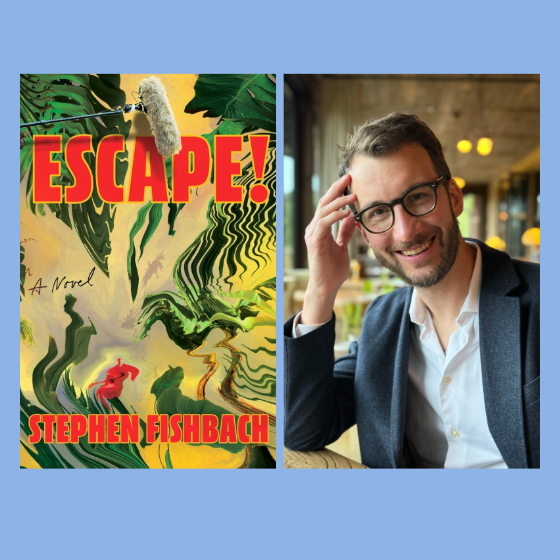
On April 24th at our Literary Debutante Ball, One Story will be celebrating five of our authors who have recently published or will soon publish their debut books. In the weeks leading up to the Ball, we’ll be introducing our Debs through a series of interviews.
Today we’re talking to Stephen Fishbach, author of One Story issue #273, “To Sharks,” and the novel Escape! (Dutton).
Escape! is a frenetic, lush novel exploring the dark heart of a reality show, from contestants surviving in a jungle to the producers manipulating their story arcs. This debut novel’s central characters are desperate for redemption, which they believe is just a well-staged clip and sound bite away. Stephen Fishbach builds on his experience as a two-time Survivor contestant to showcase the world of reality TV, where perception is key, polished highlight reels eclipse messy memories, and safety is never guaranteed. Full of twists and tenderness, Escape! interrogates who we are alone versus when everyone is watching, and who is truly in control of our stories.
—Theda Berry
Theda Berry: Where were you when you found out Escape! was going to be published? How did you celebrate?
Stephen Fishbach: I can’t remember the exact moment, but I was probably at my computer Docusigning the contract. It’s funny how many years of hard work and hope are capstoned by a Docusign. A little later, my wife and I took a trip together to the Smoky Mountains and we opened a bottle of wine from my birth year that my father had been saving for me.
TB: An excerpt from the novel, your Pushcart Prize–winning short story “To Sharks,” was published as One Story Issue #273 in 2021. The story focuses on the has-been reality TV star Kent, who is one of the novel’s protagonists, alongside fellow contestant Miriam and the redemption-seeking producer Beck. What drew you to these three central characters, amid a literal cast and crew from the book’s titular reality show who could’ve been featured?
SF: This is a great question!! With Kent and Miriam, I wanted to capture the two sides of the TV contestant coin. There’s Miriam, the naïve new contestant, who’s entering this world wide-eyed and optimistic. She wants personal growth! She wants to find her true self! Honestly, she’s the best part of a reality TV contestant, the earnest aspirant who truly is hoping for personal change. Kent is the cynical flip side. He’s seen it all, and so he was my go-to for knowing, slightly embittered commentary on the reality TV circus.
Kent and Miriam are reality TV contestants, and so I also needed to feature the storyteller. Beck was my window into the production side of reality television, someone who wants to take these chaotic messy lives and shape them into a compact three-act structure. Beck truly believes she’s doing something virtuous, gifting these players a meaningful story arc—but her best instincts lead her horribly astray.
TB: In an interview with Will Allison about writing “To Sharks,” you said, “One of the biggest challenges was trying to see the reality TV community from the outside, when I’m so deeply enmeshed in it.” The medium of fiction and your experience being immersed in that world does, however, allow you to fully explore the interiority of contestants in a rarely-before-seen way. Did that insider perspective feel like a challenge for Escape! as well? What was the research process like, to go beyond your experience as a two-time Survivor contestant and get in the mind of a producer?
SF: I spoke with dozens of producers and audio technicians and other crew. I also read countless interviews with reality producers; thanks especially to the incredible reporting from Andy Dehnart at Reality Blurred. But Beck’s central dilemma, I think, is a fundamentally human one. At least, it’s deeply meaningful for me. Beck desperately wants to shape her life experience into a tidy story. She wants victories to be deserved, and tragedies to lead to healing and growth. But how do you reckon with a tragedy that’s just random, where nothing good comes of it, that you can’t fit into a coherent narrative? In some ways, “reality TV producer” is just a metaphor for that struggle.
TB: You also mentioned in that interview that Kent struggles to let his past experience stay in the past. There are recurring visuals in Escape!—a family video from Beck’s childhood and Kent’s highlight reel from his first reality TV show Endure—that the characters return to, either literally replaying them or imagining them over and over again. How were you thinking about documentation and memory in the novel?
SF: This is a lovely question. You’re absolutely right, both Beck and Kent long for an idealized past. They both turn to edited videos that capture their halcyon moments. But any form of documentation inherently imposes a narrative. Both characters crave that: those highlight reels evoke their best selves and their happiest times. Yet that’s also what makes those documents dangerous. By cutting away everything else, the videos from the past create an impossible standard for the present.
I think that holds true for many of us. We use digital media to curate a vision of our lives, and present it to the world as the whole truth. But that curated image can become a reminder of the ideal self we’re always falling short of.
For both Kent and Beck, the challenge is seeing beyond the contours of the edited, color-corrected clips, or the snippets of old home movies, and learning to accept their lives in all their messy complexity.
TB: At many points in the book, characters are preoccupied with whether or not their efforts will end up in the final cut of Escape!, since there is an incredible amount of footage from reality TV that viewers never see. Producers and contestants can sink hours or days into an idea they are pursuing that later gets edited out of the season. In the drafting or editing phase, did you similarly make difficult cuts and lose whole storylines that you thought would make it to print?
SF: Yes!! The biggest, most painful cut for me was an entire section from the POV of Afa, the show’s audio mixer who’s in love with Erika, whom I guess you could call the “villain.” First of all, a LOT of research went into that chapter. I loved getting more of the texture of the production world, how the audio mixers hate the camera guys, because the camera guys are lazy hotshots striking power poses with their rigs. I also thought it added dimensionality to the story. The challenge with writing Erika was that you really only see her from Beck’s POV, and Beck hates her. Bringing in Afa’s voice allowed me to add nuance, and to complicate Beck’s perspective.
But! It was a thirty-page section that didn’t serve the plot right in the middle of an already-long novel. While my editor liked the chapter in a vacuum, she felt it dampened the book’s momentum. So goodbye, Afa chapter! I still miss you.
TB: On a recent episode of Adam Vitcavage’s podcast Debutiful, you said, “I do feel like there’s maybe a cultural bias against reality TV, against daring to take reality TV seriously. And I wanted to do that.” I love that idea, because, as the novel makes clear, these shows can display the full range of humanity and create profound moments for their cast, crew, and viewers. While writing Escape!, were there particular seasons of Survivor you revisited or referenced, or other reality shows that inspired you?
SF: I watched a lot of smaller-scale jungle shows—Naked and Afraid, Alone, Outlast, Stranded with a Million Dollars, Fight to Survive. Shows you’ve never heard of. I spoke with producers and contestants from those series. First and foremost, I didn’t want this to be a Survivor tell-all or a revenge novel. But beyond that, Survivor’s got hundreds of crew members living in a massive production metropolis. I wanted to evoke a series where the production apparatus is dwarfed by the surrounding jungle, so the producers’ impulse to shape and control is juxtaposed against the enormity of the chaotic natural world. Also, Survivor’s going to be renewed forever. But what about more marginal series that are competing more aggressively for audience share? That’s where producers are more incentivized to put their fingers on the scale.
TB: Lastly, what are you most looking forward to at the One Story ball?
SF: I’m most looking forward to meeting the One Story team!! Will Allison, Patrick Ryan, Lena Valencia, Maribeth Batcha… (I’ve met Hannah before.) The One Story crew has been instrumental in launching my writing career, and I really can’t wait to say thank you.
Theda Berry is a Brooklyn-based fiction writer and music journalist. She currently works at the Whitney Museum of American Art and is a reader for One Story.
