
On April 24th at our Literary Debutante Ball, One Story will be celebrating five of our authors who have recently published or will soon publish their debut books. In the weeks leading up to the Ball, we’ll be introducing our Debs through a series of interviews.
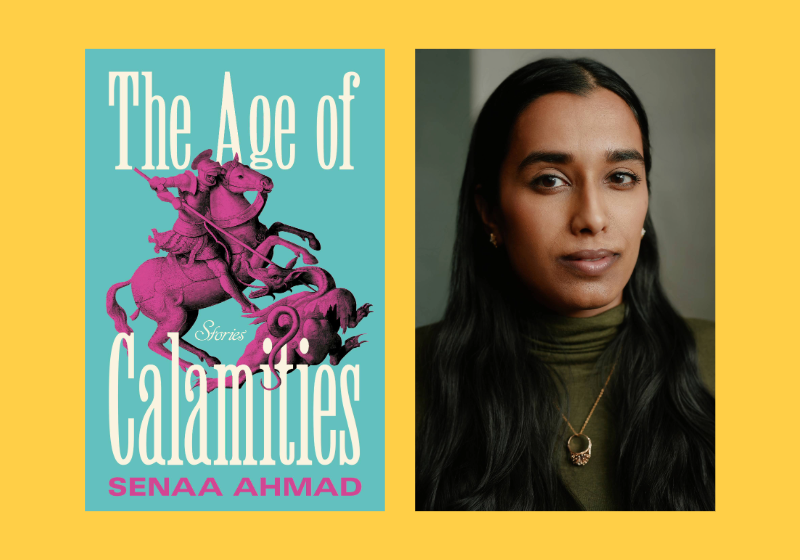
Today we’re talking to Senaa Ahmad, author of One Story #331, “Our Lady of Resplendent Misfortune” and the short story collection The Age of Calamities (Henry Holt).
The Age of Calamities asks “what if?” What if Anne Boleyn’s death wasn’t final? What if we could follow the Romanovs into the great beyond, as the children make sense of death and the adults try to redirect them at every turn? What if Napoleon Bonaparte keeps multiplying? What if a historian were able to bring notable figures together in one room, defying the limitations of time? Senaa Ahmad’s intriguing short story collection, The Age of Calamities, asks us to reexamine the historical figures and events that continue to plague and confound us, as their legacies reverberate across time and their mysteries demand an afterlife.
—Layhannara Tep
Layhannara Tep: Where were you when you found out The Age of Calamities was going to be published? How did you celebrate?
Senaa Ahmad: I started writing these stories in 2018. If you told me the whole thing wouldn’t be published until 2026, I would’ve spontaneously combusted. I say this as a preface, because I’m temperamentally impatient and I’m always trying to reconcile that raging sense of impatience with the work of writing itself, which is slow and requires a more methodical approach. The publication process felt like an extension of that.
Anyway! It was early 2024. I was in my apartment that day, working or trying to, going through the motions of my routine with this big buzzing sound in my head. I knew we were getting some news that day. My agent, Alexa Stark, called and it took a few more phone calls for me to understand this was really happening. I had stress dreams for months afterwards. I’ve had many small celebrations since then, mainly over dinners and group chats, and I feel preposterously lucky at how excited everyone’s been.
LT: Each story in The Age of Calamities has its origins in a real historical figure or event. What drew you to the people and events that each story is based on? What is the common thread between the people and events you selected?
SA: I knew I was writing for a predominantly English-speaking audience, so I was looking for historical figures with that in mind. People who came with cultural baggage to their names, like Julius Caesar. My interest in the collection was the idea of tugging on those expectations in hopefully surprising and pleasing ways.
Often, the concept emerged first and the connection to the historical figure came afterwards. The research into each figure or their historical period would frequently deepen the story. One of the things that crystallized “Our Lady of Resplendent Misfortune” was Joan of Arc’s recurring visions of saints, which was so eerie that it immediately brought out the horror and flavor of the story.
LT: Some of the characters in your stories resist the finality of death—at times literally, through the continual death and resurrection of Anne Boleyn, and at other times spiritually, through the liminal spaces that the Romanovs traverse in the aftermath of a collective execution, or through Joan of Arc’s possession of a descendant’s body. What does it mean to give these characters a second (and at times third and fourth) life? What do they resist when they resist death?
SA: At the time I started writing the collection, I was especially interested in the complications and contradictions of survival. How people survive large-scale historical horrors or don’t, how they live through individual acts of violence, how they manage to stay present through the mundane dread of difficult periods in history, and how they make meaning of their lives throughout all of this.
That preoccupation lay underneath many of these stories, some more overtly than others. In the collection, these concerns don’t end with death. They’re still there, on the other side, all the regrets and fixations of life, often heightened by the passage of time.
LT: Your stories “Inside the House of the Historian,” “Not Everything Is Ancient History,” “The Houseguest,” and “Choose Your Own Apocalypse” each challenge the nature of time and space. On a craft level, what can we accomplish when we are willing to defy the linearity of time and the rigidity of space? How can embracing a more fluid approach to time and space open new possibilities for storytelling?
SA: I’d be remiss if I didn’t start by recommending Jane Allison’s Meander, Spiral, Explode, which is a really satisfying exploration of story patterns. Short stories in particular allow for a lot of that freedom in form and experimentation. Sofia Samatar is a genius at it, especially in Tender, her first collection.
On a craft level, it can make you pay close attention to the mechanics of a story. What pieces make up the story, how each one functions on its own and as part of the whole, how momentum is generated in the movement from one piece to another. How the structure itself undercuts or amplifies forward progress. I wanted the reader to have a heightened awareness of these stories as constructions, sometimes as acts of deception, often told by narrators with their own undisclosed intentions.
LT: I am curious about the theme of complicity in your stories “The Wolves,” and “The Napoleons Are Multiplying.” While distinct, each story draws on the legacy of a notorious conqueror and the impact of war on the collective psyche. In “The Wolves,” werewolves become a stand-in for Genghis Khan’s conquering armies, and his werewolf followers multiply in violent and deliberate ways. In “The Napoleons Are Multiplying,” Napoleon clones appear without reason or logic, each at different times, each without purpose, and each disturbing the universe in a specific and unique way. What does each story attempt to say about the concept of influence and the nature of our complicity, whether deliberate or mindless?
SA: It’s funny, I wouldn’t have necessarily connected those two stories with that thread, but I did want to explore the idea of conquest for the sake of conquest. Or, on a smaller scale in “The Napoleons,” wanting things simply to have them, without understanding why. Trying to fill a void by taking and taking. Not seeing what this loss represents to others, or not believing it matters.
I’m always interested in how people narrativize their lives, and how they situate themselves in those stories to avoid blame or to save face. I often think of two documentaries about people who have done violence but struggle to face the entirety of their actions. The Act of Killing deals with this on a large scale, A Better Man on a more personal level. Ordinary people can be capable of great monstrosity, sometimes careless monstrosity, and I wanted to explore that within the collection.
LT: Lastly, what are you most looking forward to at the One Story ball?
SA: I’m excited to meet the other debuts, to finally say hello and thank you to the One Story team, to listen to Lauren Groff’s speech, to meet lots of people I’ve been in touch with but never met face-to-face.
I’ve known about the Debutante Ball for years, and it’s such a delight to finally attend, and doubly, triply, a pleasure to be one of the debuts. And I haven’t been to New York in years, so I can’t wait to get inexplicably lost within minutes of arrival.
Layhannara Tep is the daughter of Cambodian refugees and a writer of fiction. Born and raised in Long Beach, California, Layhannara earned her MFA in fiction at NYU. Her work can be found in Aster(ix) Journal and The Hopkins Review.